Bulgaria’s VAT bill for mandatory e-invoicing from 1 July 2028 and a EUR 60,000–75,000 registration threshold passes first reading (not yet law)
This change is proposed and is not law. The rules below describe what would change if it is adopted.
This page records one dated change. For the rules in Bulgaria as they stand today, see the Bulgaria guide →
- Jurisdiction
- Bulgaria
- Tax
- VAT
- Change type
- E-invoicing
- Status
- Proposed
- Impact
- Plan ahead
- Announced
- 5 November 2026
- Effective
- 1 January 2027
- Authority
- Народно събрание (National Assembly of Bulgaria)
- Systems
- Invoicing, ERP, Reporting
- Verified
- Fetched from official source · high confidence
Businesses registered for VAT in Bulgaria, which would issue and receive structured e-invoices for domestic supplies, and small businesses near the registration threshold (currently EUR 51,130).
Businesses VAT-registered in Bulgaria: plan for structured e-invoicing through the national portal from 1 July 2028 (registering an e-invoice receiving address by 30 June 2028) and for the higher registration thresholds, subject to the bill being adopted.
InvoicingERPReporting
The Bulgarian government submitted to the National Assembly on 5 November 2026 a bill amending the VAT Act (ЗДДС; ref. 52-602-01-60). It introduces mandatory structured e-invoicing for domestic supplies, with the national data-submission system and the national structured e-invoicing portal going live from 1 July 2028 after a test period from 1 January 2028, and replaces the EUR 51,130 VAT registration threshold with a phased national threshold of EUR 60,000 from 1 January 2027, EUR 70,000 from 1 January 2028 and EUR 75,000 from 1 January 2029. The National Assembly adopted the bill at first reading on 12 November 2026; the second reading is pending.
What changed in detail
This is a bill, not yet law. On 5 November 2026 the Council of Ministers (Decision No. 843 of 2026) submitted to the National Assembly a bill amending and supplementing the Value Added Tax Act (ЗДДС), registered as No. 52-602-01-60. The National Assembly adopted it at first reading on 12 November 2026 (122 for, 49 against, 18 abstentions); the second reading is pending.
Under the bill:
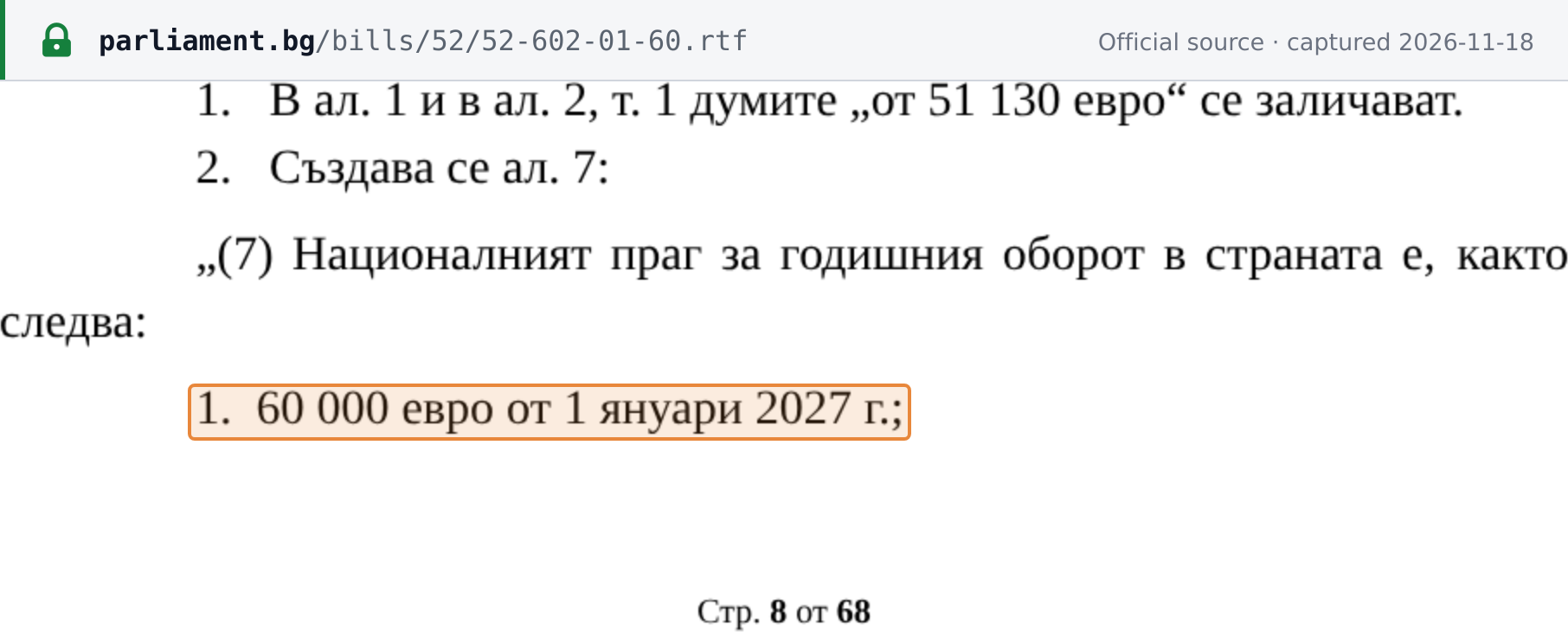
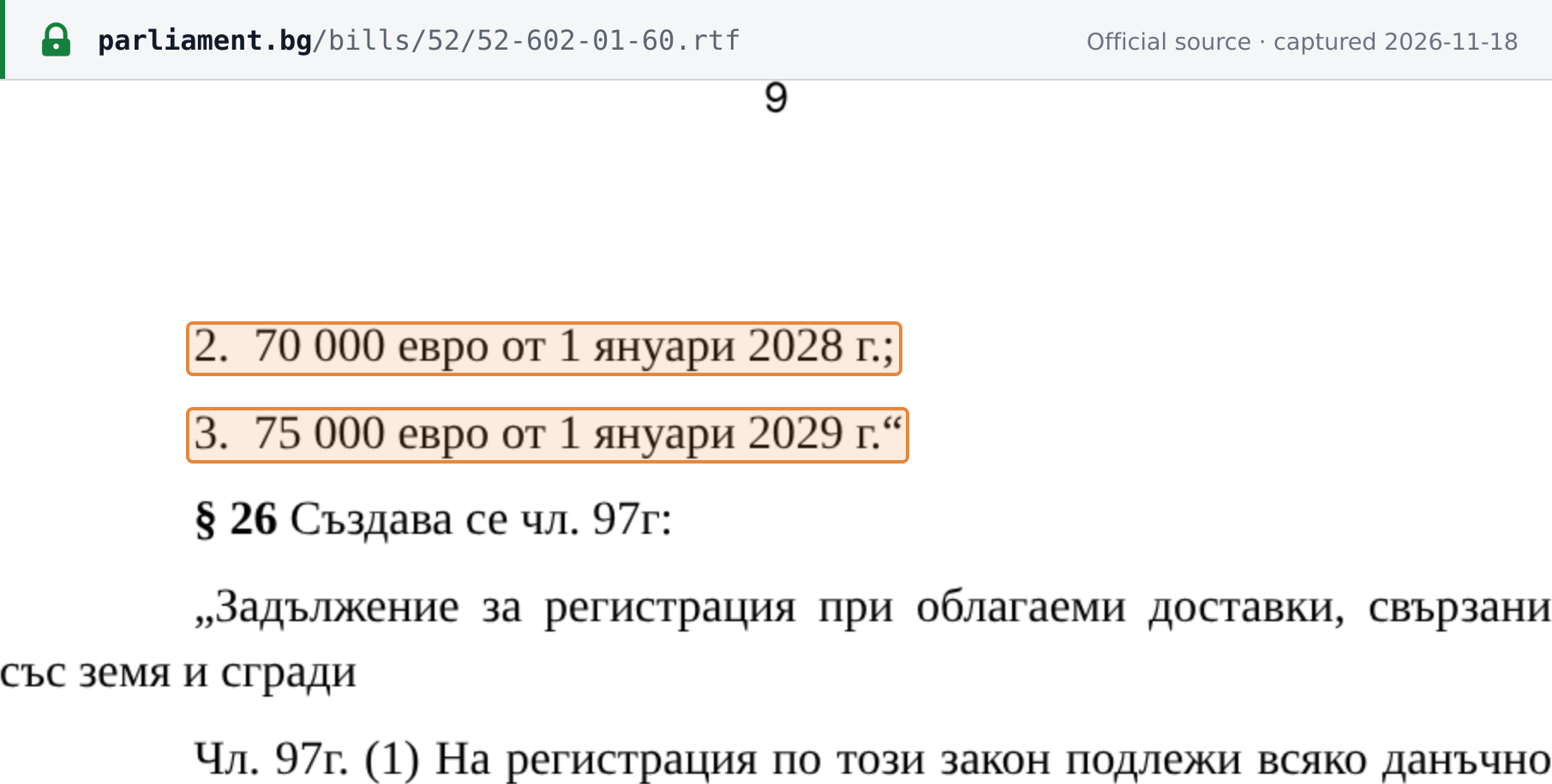
- Registration threshold. Article 96 would lose the fixed EUR 51,130 figure and gain a new paragraph 7 setting a national annual-turnover threshold of EUR 60,000 from 1 January 2027, EUR 70,000 from 1 January 2028 and EUR 75,000 from 1 January 2029.
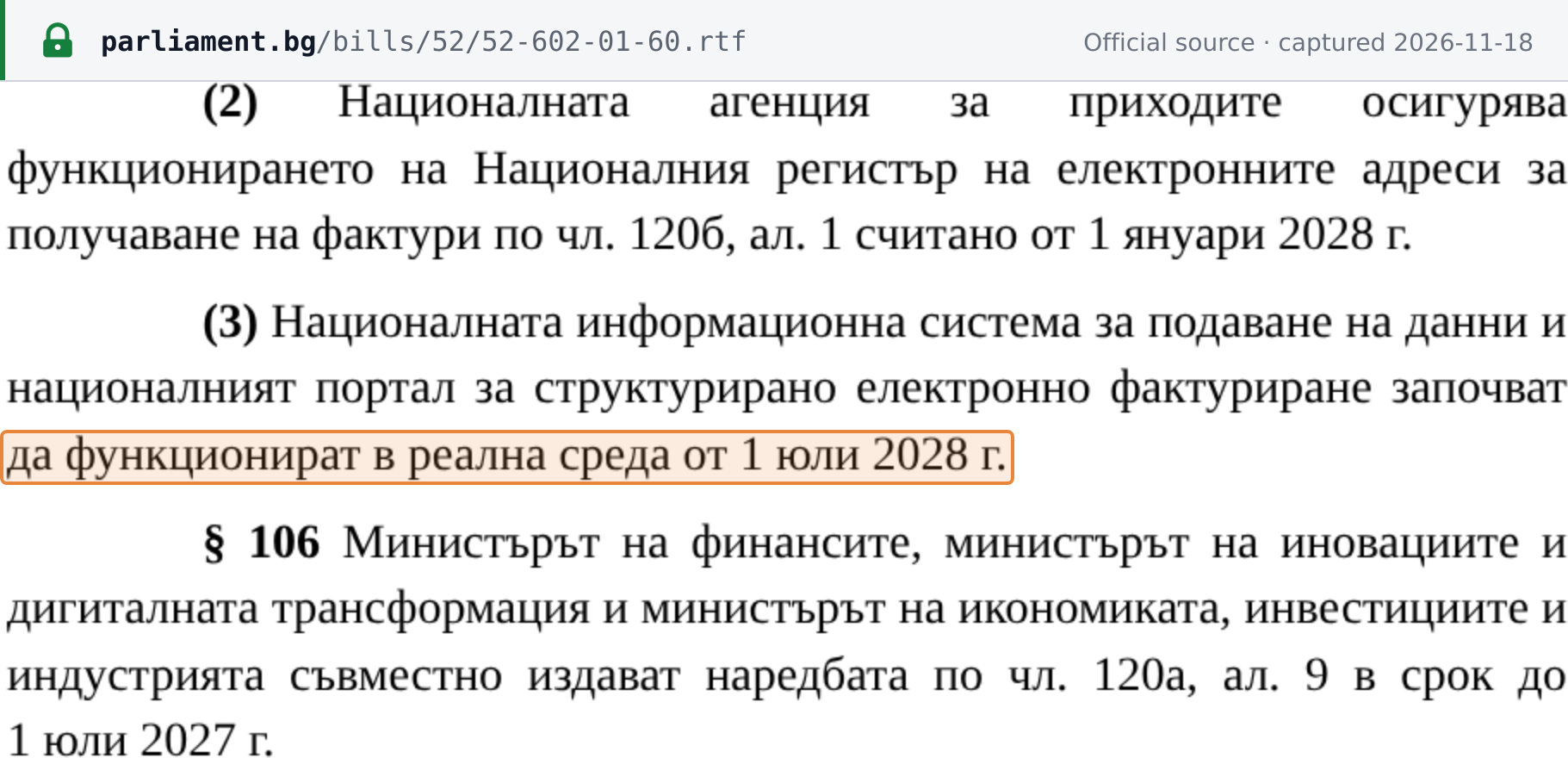
- E-invoicing timeline. The National Revenue Agency would give VAT-registered persons access to a test environment of the national data-submission system and the national structured e-invoicing portal from 1 January to 30 June 2028, and run the national register of electronic addresses for receiving invoices from 1 January 2028. The system and the portal would go live from 1 July 2028.
- Receiving address. Persons VAT-registered at 1 January 2028 would have to declare, by 30 June 2028, their electronic address for receiving structured e-invoices for entry in that register.
- The implementing ordinance would be issued jointly by three ministers by 1 July 2027.
The law would enter into force on 1 January 2027, with the e-invoicing provisions applying from 1 July 2028 and certain others from 1 January 2029 and 1 July 2029.
This bill succeeds the draft published for consultation in September 2026 and the draft registration-threshold change.
What it means
Two very different timelines sit in one bill. The threshold rise is meant to apply from 1 January 2027, so the second reading and promulgation have to follow within weeks for that date to hold; a business with turnover between EUR 51,130 and EUR 60,000 should not deregister on the strength of a bill. The e-invoicing mandate gives eighteen months: plan ERP integration with the national portal, test in the first half of 2028, and register a receiving address before 30 June 2028. Parliament can still change the dates.
Proof
(3) Националната информационна система за подаване на данни и националният портал за структурирано електронно фактуриране започват да функционират в реална среда от 1 юли 2028 г.(3) The national information system for data submission and the national portal for structured electronic invoicing shall begin operating in a live environment from 1 July 2028.
 Source snapshot of the official page. Open full size ↗
60 000 евро от 1 януари 2027 г.;EUR 60,000 from 1 January 2027;
 Source snapshot of the official page. Open full size ↗
75 000 евро от 1 януари 2029 г.EUR 75,000 from 1 January 2029.
 Source snapshot of the official page. Open full size ↗
Sources
What this replaces
- Not law: Bulgaria drafts mandatory B2B/B2G structured e-invoicing from 2028 effective 1 January 2028
- Not law: Bulgaria drafts a EUR 75,000 VAT registration threshold for 2027 effective 1 January 2027