Canada requires GST/HST payments of $10,000 or more to be made electronically from 1 January 2024, with a $100 penalty per failure
This page records one dated change. For the rules in Canada as they stand today, see the Canada guide →
- Jurisdiction
- Canada
- Tax
- GST/HST
- Change type
- Compliance
- Status
- In force
- Impact
- Action required
- Announced
- 1 January 2024
- Effective
- 1 January 2024
- Instrument
- CA-ACT-OF-PARLIAMENT-S-C-2023-c-26
- Authority
- Department of Justice Canada (Justice Laws Website)
- Verified
- Fetched from official source · high confidence
Every person required to pay or remit GST/HST of $10,000 or more to the Receiver General; for the e-filing change, registrants other than charities that meet the mandatory electronic-filing conditions.
GST/HST registrants must make any payment or remittance of $10,000 or more to the Receiver General electronically (unless they cannot reasonably do so); each failure attracts a $100 penalty under ETA s. 280.12. Registrants other than charities that meet the mandatory e-filing conditions must file GST/HST returns electronically.
In force from January 1, 2024: the Budget Implementation Act, 2023, No. 1 (S.C. 2023, c. 26), assented to June 22, 2023, requires GST/HST payments and remittances of $10,000 or more to be made by electronic payment (Excise Tax Act s. 278(3), for payments and remittances made after 2023) and imposes a $100 penalty for each failure (new s. 280.12). Section 112 also amends paragraph 2(a) of the Electronic Filing and Provision of Information (GST/HST) Regulations so that only charities fall outside the mandatory electronic filing condition, for reporting periods beginning after 2023.
What changed in detail
The Budget Implementation Act, 2023, No. 1 (S.C. 2023, c. 26) received Royal Assent on 22 June 2023. Three of its GST/HST provisions took effect on 1 January 2024.
- Section 81 adds a definition of electronic payment to Excise Tax Act s. 278 (0.1): a payment or remittance to the Receiver General made through the electronic services of a bank or other listed institution, or by any electronic means the Minister specifies. It rewrites s. 278(3) so that every person required to pay or remit an amount under Part IX must, if the amount is $10,000 or more, make it by electronic payment, unless the person cannot reasonably pay that way. This applies to payments and remittances made after 2023.
- Section 82 adds s. 280.12: every person that fails to comply with s. 278(3) is liable to a penalty of $100 for each failure, for payments and remittances made after 2023.
- Section 112 replaces paragraph 2(a) of the Electronic Filing and Provision of Information (GST/HST) Regulations to read “the person is not a charity”, for reporting periods beginning after 2023. Only charities now fall outside that condition of the mandatory electronic-filing rule.
The Act was passed in 2023. The rules bite from 1 January 2024.
What it means
The rule is still in force. The consolidated Excise Tax Act and the Electronic Filing Regulations show no later change to these provisions.
The penalty is per payment, not per return. A business that mails a cheque for a large balance every quarter builds up $100 each time. The “cannot reasonably” exception is not defined in the section, so a business without electronic banking should set it up rather than rely on the exception.
The section words the $10,000 test as the amount a person is required to pay or remit, so the size of the balance due, not the payment channel the business prefers, decides whether the rule applies.
Proof
Every person that fails to comply with subsection 278(3) is liable to a penalty equal to $100 for each such failure.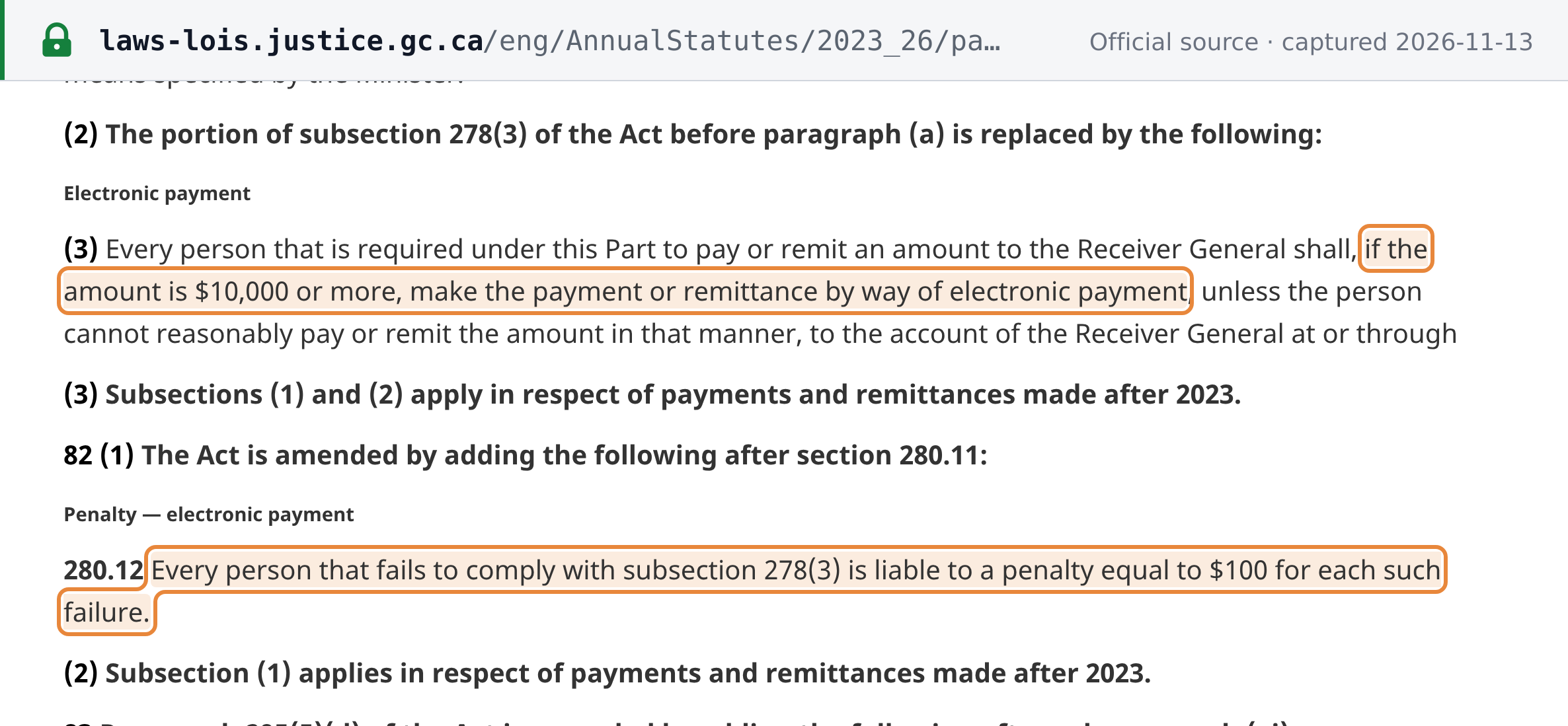 Source snapshot of the official page. Open full size ↗
Archived from the official distribution · Budget Implementation Act, 2023, No. 1, S.C. 2023, c. 26 (annual statute, Justice Laws Website PDF) · laws-lois.justice.gc.ca