Estonia lets registered buyers require e-invoices from their suppliers from 1 July 2025
This page records one dated change. For the rules in Estonia as they stand today, see the Estonia guide →
- Jurisdiction
- Estonia
- Tax
- VAT
- Change type
- E-invoicing
- Status
- In force
- Impact
- FYI
- Announced
- 10 October 2024
- Effective
- 1 July 2025
- Instrument
- EE-ACT-RT-I-10-10-2024-1
- Authority
- Riigi Teataja
- Verified
- Fetched from official source · high confidence
Estonian accounting entities (raamatupidamiskohustuslased) that sell goods or services to a buyer registered as an e-invoice recipient in the Commercial Register.
No action — monitoring only.
Raamatupidamise seaduse muutmise seadus (Accounting Act amendment), adopted by the Riigikogu on 18 September 2024 and published in Riigi Teataja on 10 October 2024 (RT I, 10.10.2024, 1), in force 1 July 2025: an accounting entity that wants to receive only machine-readable invoices (e-invoices) registers as an e-invoice recipient in the Commercial Register, and an entity so registered may require its seller to issue an e-invoice for goods or services it buys. An e-invoice is presumed compliant if it meets European standard EN 16931-1; the parties may agree another appropriate standard.
What changed in detail
The Raamatupidamise seaduse muutmise seadus (Act amending the Accounting Act) was adopted by the Riigikogu on 18 September 2024, proclaimed by the President on 2 October 2024 (decision no. 460) and published in Riigi Teataja on 10 October 2024 as RT I, 10.10.2024, 1. Under its § 2 the whole Act entered into force on 1 July 2025.
Section 1 rewrites § 7¹ of the Accounting Act:
- § 7¹(3): an accounting entity that wants to receive only machine-readable invoices (e-arve), or a person it has contracted to handle its e-invoices, notifies the Commercial Register. The register marks the entity as an e-invoice recipient and records its e-invoice operator code or other receiving channel.
- § 7¹(7): an entity so registered may require the seller to issue an e-invoice for goods or services it buys. An e-invoice is presumed correctly drawn up if it complies with European standard EN 16931-1; the parties may agree to use another appropriate standard.
- § 7¹(4)–(6) and (10)–(11) are repealed.
The Act also restates § 31(2)(9) on consolidated financial ratios and replaces Annex 1 (the balance sheet format), which are not e-invoicing changes.
What it means
The rule has applied since 1 July 2025 and is still in force: the consolidated Accounting Act (RT I, 10.07.2025, 3) carries § 7¹(3) and (7) in the wording above.
This is a buyer-triggered obligation, not a general mandate. A seller has to issue EN 16931-1 e-invoices to a customer only once that customer is registered as an e-invoice recipient and asks for them, so suppliers should check the Commercial Register status of their customers rather than assume paper or PDF invoices remain acceptable. Any accounting entity can be on either side, whether or not it is VAT-registered.
Proof
Käesoleva paragrahvi lõike 3 kohaselt äriregistris e-arve vastuvõtjaks märgitud raamatupidamiskohustuslane võib soetatud kauba või teenuse eest tasumiseks nõuda müüjalt e-arve esitamist. Eeldatakse, et e-arve on vormistatud nõuetekohaselt, kui see vastab e-arveldamise Euroopa standardile EN 16931-1.An accounting entity registered as an e-invoice recipient in the Commercial Register under subsection 3 of this section may require the seller to submit an e-invoice for payment for goods or services purchased. An e-invoice is presumed to be correctly drawn up if it complies with European e-invoicing standard EN 16931-1.
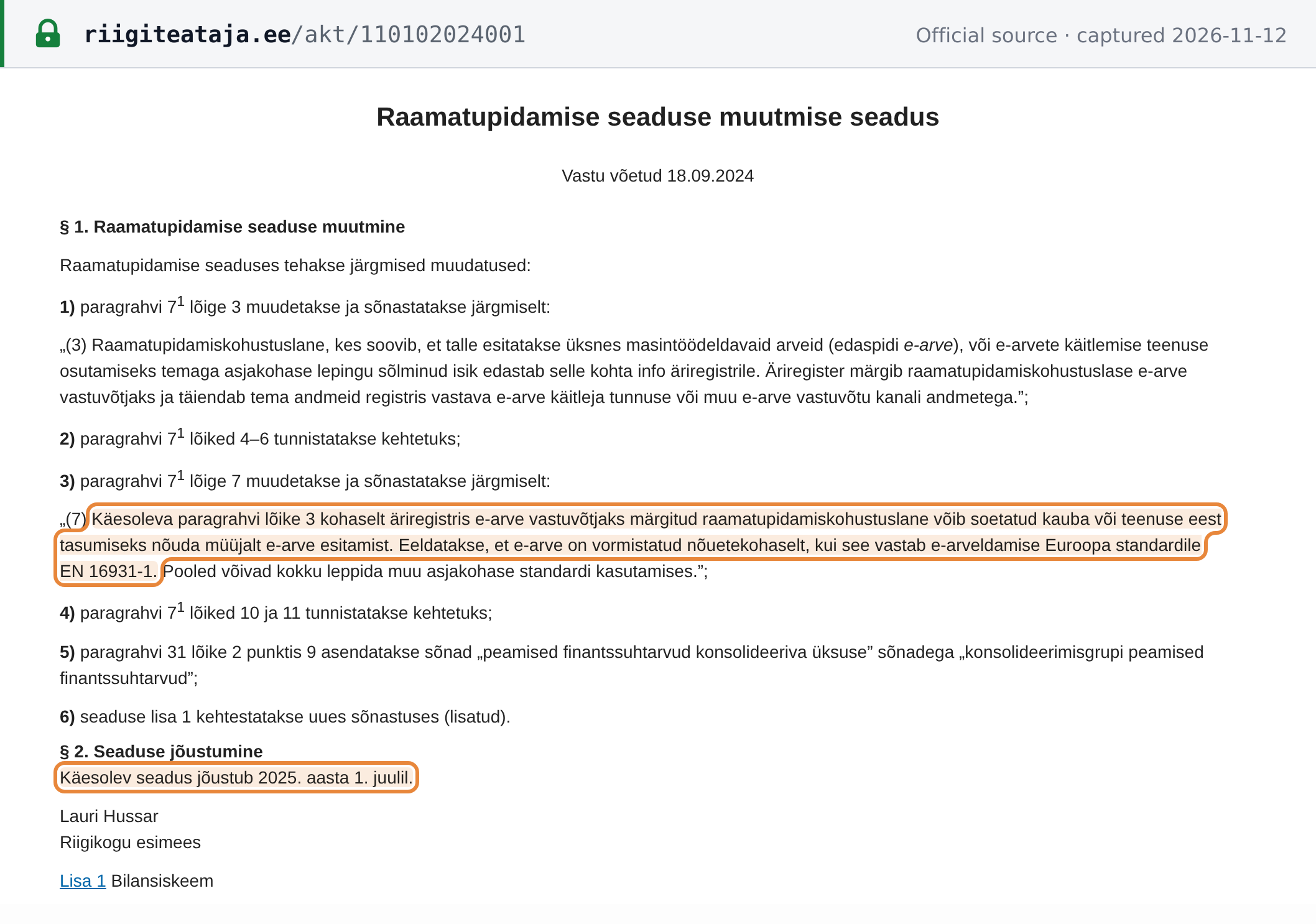 Source snapshot of the official page. Open full size ↗