EU adopts VAT in the Digital Age: e-invoicing, platform rules and single registration phased in from 2025 to 2035
- Jurisdiction
- European Union
- Tax
- VAT
- Change type
- E-invoicing
- Status
- Enacted
- Impact
- Plan ahead
- Announced
- 25 March 2025
- Instrument
- EU-DIRECTIVE-2025-516
- Authority
- Official Journal of the European Union (EUR-Lex)
- Verified
- Fetched from official source · high confidence
All EU VAT-registered businesses making cross-border B2B supplies, platforms facilitating accommodation, passenger transport or goods sales, and users of the OSS schemes.
Businesses with cross-border EU supplies should track member-state implementation of digital reporting requirements ahead of the 2027–2030 phased application.
Council Directive (EU) 2025/516 of 11 March 2025 (VAT in the Digital Age, ViDA), published in OJ L 2025/516 on 25 March 2025, amends Directive 2006/112/EC in stages. From 14 April 2025 Member States may mandate domestic B2B e-invoicing without an EU derogation or the recipient's acceptance. From 1 January 2027 the deemed-supplier rule covers platforms facilitating intra-EU supplies of goods by non-EU sellers and the OSS schemes are extended. From 1 July 2028 platforms facilitating short-term accommodation rental and road passenger transport become deemed suppliers (Member States may delay this until 1 January 2030), and a transfer-of-own-goods OSS scheme starts. From 1 July 2029 further changes apply. From 1 July 2030 structured e-invoicing becomes the default and transaction-based digital reporting applies to intra-EU B2B supplies. Member States that had domestic real-time reporting in place before 2024 have until 1 January 2035 to align their domestic systems.
What changed in detail
Council Directive (EU) 2025/516 of 11 March 2025 amends the VAT Directive (2006/112/EC) “as regards VAT rules for the digital age”. It was published on 25 March 2025 (OJ L, 2025/516) and entered into force twenty days later. Article 6 phases it in:
- 14 April 2025 (Article 1). Member States may apply the new Article 218 paragraph and the Article 232 change at once: they may require businesses established on their territory to issue e-invoices for domestic supplies without an EU derogation, and, where they do, may dispense with the recipient’s acceptance of those e-invoices.
- 1 January 2027 (Article 2). The deemed-supplier rule in Article 14a(2) is recast to cover platforms facilitating intra-EU supplies of goods by non-EU sellers, and the One Stop Shop schemes are extended.
- 1 July 2028 (Article 3). Platforms facilitating short-term accommodation rental (up to 30 nights) or road passenger transport become deemed suppliers unless the provider gives its VAT number and declares it will charge the VAT (new Article 28a); Member States must apply this point at the earliest from 1 July 2028 and at the latest from 1 January 2030. A transfer-of-own-goods OSS scheme is added.
- 1 July 2029 (Article 4). Articles 243(3) and 262(2) are deleted.
- 1 July 2030 (Article 5). E-invoices to the European standard become the default, and transaction-based digital reporting replaces recapitulative statements for intra-EU B2B supplies.
- 1 January 2035. Member States that had domestic real-time reporting in place, authorised or legislated before 1 January 2024 have until this date to align their domestic e-invoicing and reporting with Articles 218, 271a and 271b.
What it means
ViDA is enacted and mid-rollout. Only the 2025 option is live: Member States no longer need Council permission to mandate domestic B2B e-invoicing. The 2027 platform and OSS changes come next, and their OSS/IOSS return format is set by Implementing Regulation (EU) 2026/1869. The platform deemed-supplier date is not uniform: a Member State can start it anywhere between mid-2028 and January 2030. The information-exchange and record-keeping halves of the package are Regulation (EU) 2025/517 and Implementing Regulation (EU) 2025/518.
Proof
By way of derogation from the first paragraph of this Article, Member States may, in accordance with the conditions they lay down, require taxable persons established within their territory to issue electronic invoices for supplies of goods and services within their territory, other than those referred to in Article 262.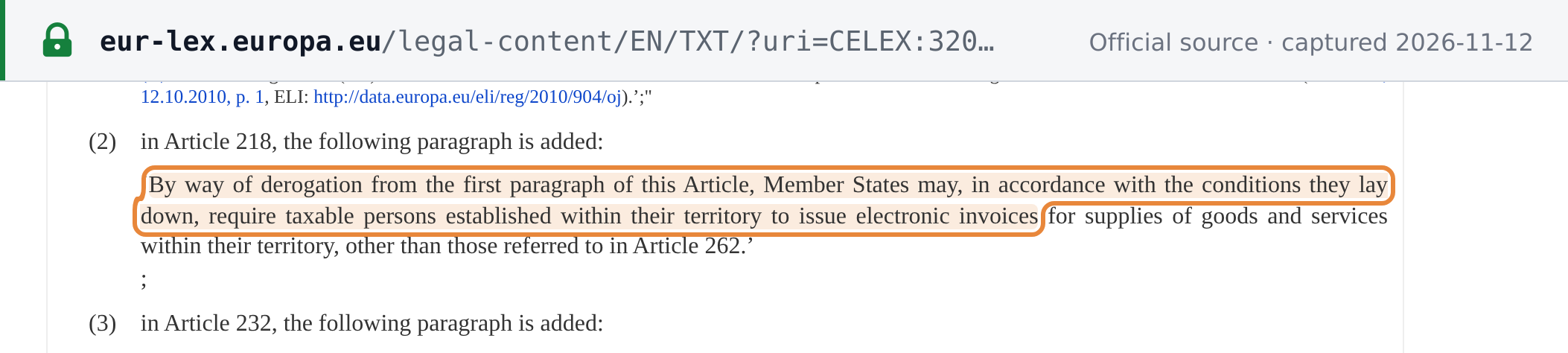 Source snapshot of the official page. Open full size ↗
Archived from the official distribution · Council Directive (EU) 2025/516 of 11 March 2025 · OJ L, 2025/516, 25.3.2025 · publications.europa.eu
Member States shall adopt and publish, by 30 June 2028, the laws, regulations and administrative provisions necessary to comply with Article 3. They shall immediately inform the Commission thereof. They shall apply those measures from 1 July 2028. By way of derogation from the second subparagraph of this paragraph, Member States shall apply the measures necessary to comply with Article 3, point (1), at the earliest from 1 July 2028 and at the latest from 1 January 2030.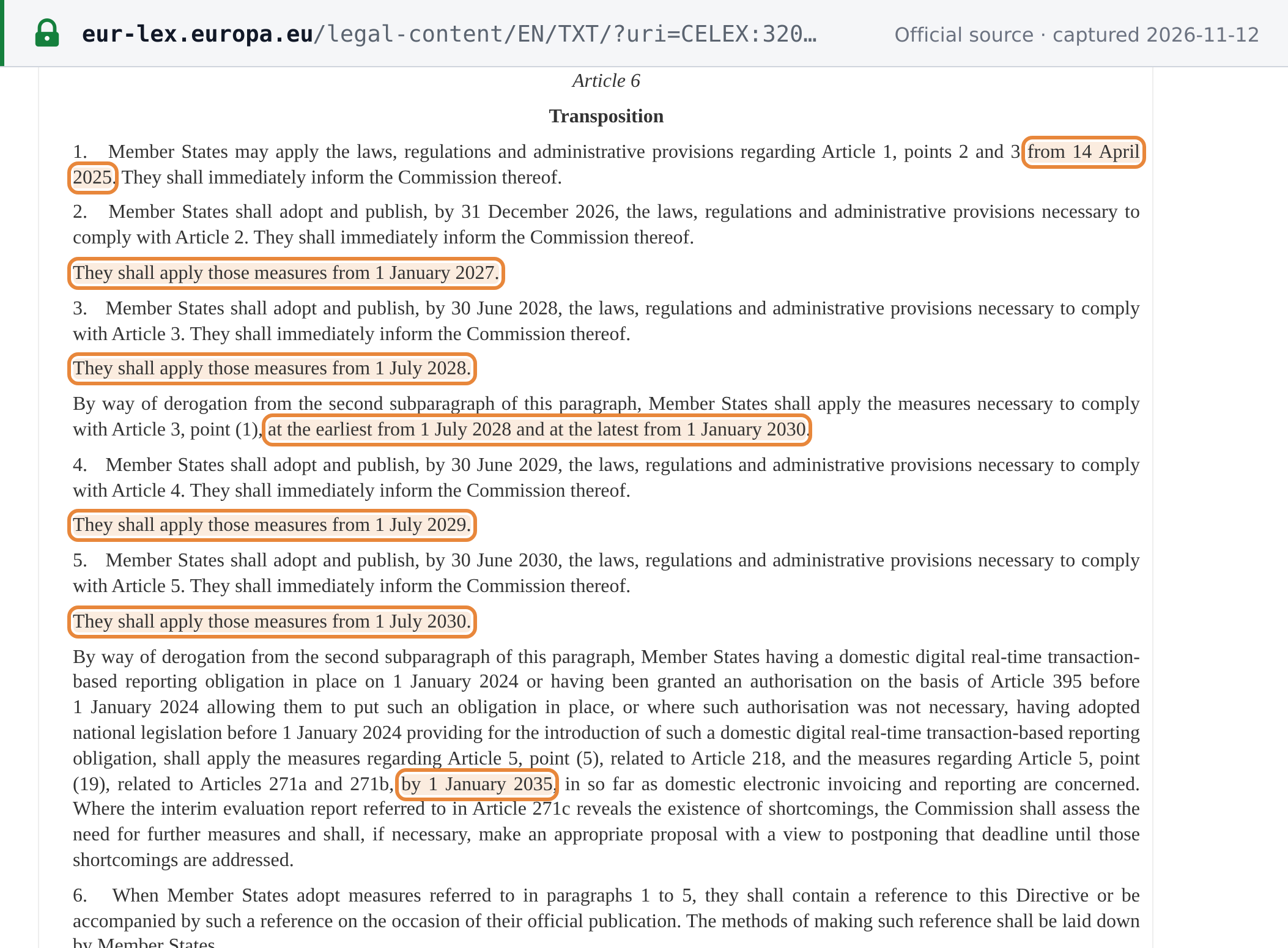 Source snapshot of the official page. Open full size ↗
Archived from the official distribution · Council Directive (EU) 2025/516 of 11 March 2025 · OJ L, 2025/516, 25.3.2025 · publications.europa.eu