Germany delays full VAT rules for public bodies (§ 2b UStG) by two more years, to 2027
This page records one dated change. For the rules in Germany as they stand today, see the Germany guide →
- Jurisdiction
- Germany
- Tax
- VAT
- Change type
- Registration
- Status
- In force
- Impact
- Plan ahead
- Announced
- 5 December 2024
- Effective
- 1 January 2025
- Instrument
- DE-ACT-BGBl-2024-I-Nr-387-Art-25
- Authority
- Bundesministerium der Justiz (Bundesgesetzblatt)
- Verified
- Fetched from official source · high confidence
Legal entities under public law in Germany (municipalities, universities, churches, chambers and similar bodies) that opted to keep the old § 2 Abs. 3 UStG rules.
Public-law bodies (municipalities, universities, churches, etc.) that declared they are applying old § 2 Abs. 3 and have not revoked that declaration must prepare for mandatory § 2b compliance from 1 January 2027. No further extension is expected.
The Jahressteuergesetz 2024 (BGBl. 2024 I Nr. 387, published 5 December 2024), Art. 25, amended the transitional rule in § 27 Abs. 22a UStG with effect from 1 January 2025 so that legal entities under public law that declared they would keep applying the old § 2 Abs. 3 UStG may do so for all supplies made before 1 January 2027 (previously 1 January 2025). Full application of § 2b UStG to them is therefore delayed by two years, to 1 January 2027.
What changed in detail
The Jahressteuergesetz 2024 of 2 December 2024 was published on 5 December 2024 as BGBl. 2024 I Nr. 387. Article 25 Nr. 24(a) amends the transitional rule for public bodies in § 27 Abs. 22a UStG. Under Article 56(7) it took effect on 1 January 2025.
§ 2b UStG, introduced in 2015, sets when a legal entity under public law (juristische Person des öffentlichen Rechts) is a taxable person. Under § 27 Abs. 22, a body could declare that it would keep applying the old § 2 Abs. 3 UStG, under which it was taxable only through its commercial operations (Betriebe gewerblicher Art). That declaration originally covered supplies up to the end of 2020. It had already been extended twice, most recently to supplies made before 1 January 2025.
Article 25 moves both dates in § 27 Abs. 22a Satz 1 by two years:
- the declaration must not have been revoked for periods ending before 1 January 2025 (previously 1 January 2023); and
- it then covers all supplies made after 31 December 2020 and before 1 January 2027 (previously 1 January 2025).
A body can still revoke the declaration, but only from the start of a following calendar year, and only for all its activities at once.
What it means
This is the last deferral on the books. The consolidated § 27 Abs. 22a UStG still ends the transition on 31 December 2026, and the Jahressteuergesetz 2026 government bill (Bundestag-Drucksache 21/8283) does not extend it. Unless a later law does, every public body becomes subject to § 2b UStG for supplies from 1 January 2027.
From then on, a municipality or university is a taxable person for any activity it carries out on a private-law basis, and for public-law activities that could distort competition. That means checking every service sold to third parties, such as room hire, catering, car parks and shared services between municipalities, for VAT, invoicing and the B2B e-invoicing duties that come with it.
Other changes made by the Jahressteuergesetz 2024: education exemption recast, farmers’ flat rate cut, coach operators in the OSS, 7% for art and collectors’ items, VAT warehouse abolished, streamed services taxed where the consumer lives, cash-accounting invoice note from 2028, Kleinunternehmer thresholds.
Proof
gilt die Erklärung auch für sämtliche Leistungen, die nach dem 31. Dezember 2020 und vor dem 1. Januar 2027 ausgeführt werden.(… and has not revoked the declaration for periods ending before 1 January 2025,) the declaration also applies to all supplies made after 31 December 2020 and before 1 January 2027.
 Source snapshot of the official page. Open full size ↗
In Absatz 22a Satz 1 wird die Angabe „1. Januar 2023“ durch die Angabe „1. Januar 2025“ und die Angabe „1. Januar 2025“ durch die Angabe „1. Januar 2027“ ersetzt.In paragraph 22a sentence 1 the date "1 January 2023" is replaced by "1 January 2025" and the date "1 January 2025" by "1 January 2027".
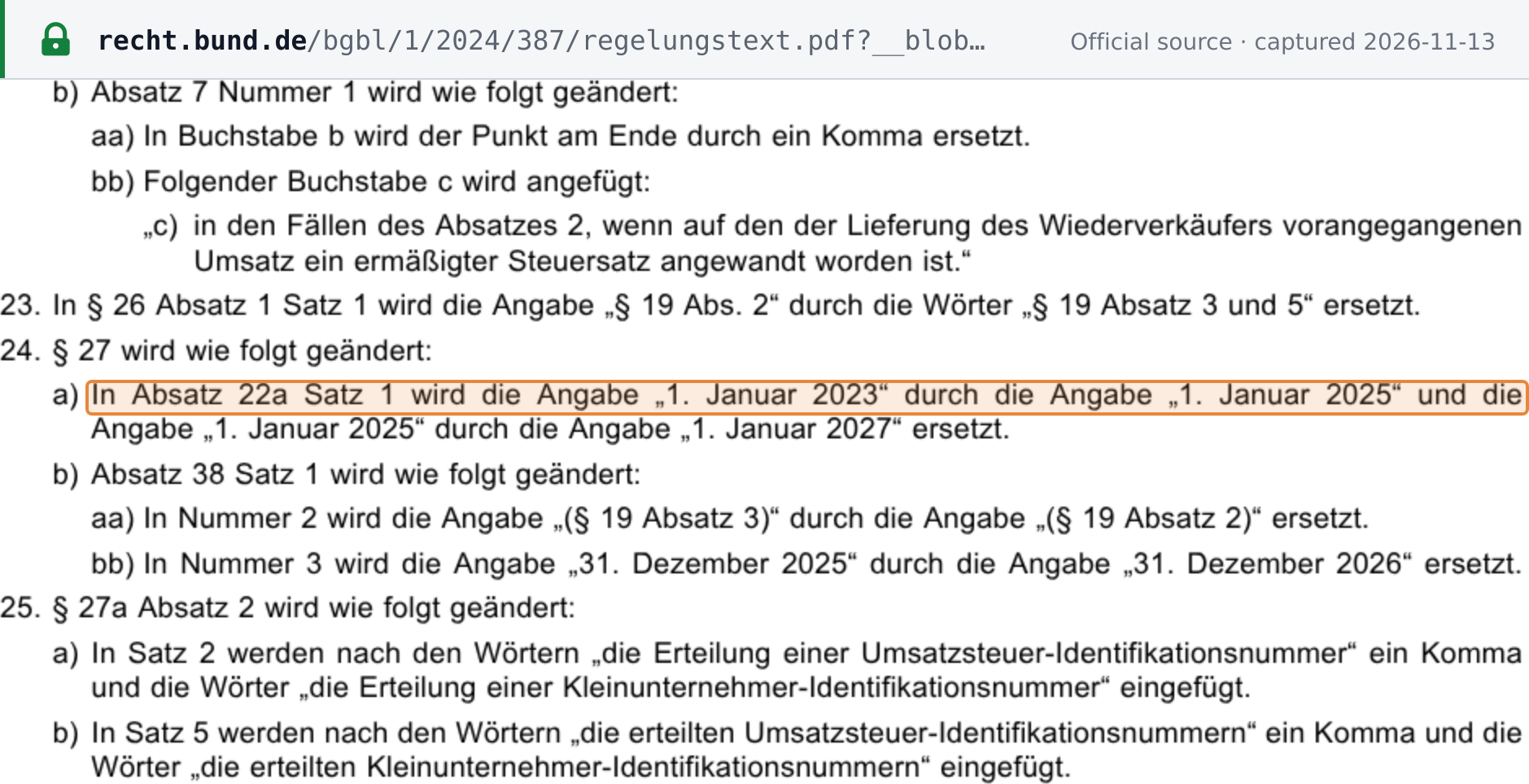 Source snapshot of the official page. Open full size ↗
Archived from the official distribution · BGBl. 2024 I Nr. 387, Jahressteuergesetz 2024 vom 2. Dezember 2024, ausgegeben am 5. Dezember 2024; Artikel 25 Nummer 24 Buchstabe a (page 45), Artikel 56 Absatz 7 (page 63) · www.recht.bund.de