Germany frees small businesses (Kleinunternehmer) from the annual VAT return, starting with 2024
This page records one dated change. For the rules in Germany as they stand today, see the Germany guide →
- Jurisdiction
- Germany
- Tax
- VAT
- Change type
- Compliance
- Status
- In force
- Impact
- FYI
- Announced
- 27 March 2024
- Effective
- 1 January 2025
- Instrument
- DE-FEDERAL-ACT-BGBl-2024-I-Nr-108-Art-23
- Authority
- Bundesministerium der Justiz (Bundesgesetzblatt)
- Verified
- Fetched from official source · high confidence
Small businesses in Germany using the § 19 UStG small-business scheme (Kleinunternehmer).
Kleinunternehmer (small businesses under § 19 UStG) no longer file an annual VAT return (§ 18 Abs. 3) for calendar years ending after 31 December 2023, unless the Finance Office requests one. No action required otherwise.
The Wachstumschancengesetz (BGBl. 2024 I Nr. 108, 27 March 2024), Art. 23, amended § 18 Abs. 3 Satz 1 and § 19 Abs. 1 Satz 4 UStG so that small businesses under § 19 UStG (Kleinunternehmer) no longer have to file an annual VAT return, and reworded the opt-out in § 19 Abs. 2 so the waiver can be declared until the end of the second calendar year after the tax period. Article 23 entered into force on 1 January 2025; under the new § 27 Abs. 39 UStG the rules apply first to tax periods ending after 31 December 2023, i.e. from the 2024 annual return. The Jahressteuergesetz 2024 carried the exclusion into the reformed § 19 from 1 January 2025.
What changed in detail
The Wachstumschancengesetz of 27 March 2024 (BGBl. 2024 I Nr. 108, published the same day) amends the small-business rules in Article 23. Under Article 35(6), Article 23 entered into force on 1 January 2025. But a new § 27 Abs. 39 UStG makes the changes apply first to tax periods ending after 31 December 2023, so they already covered the 2024 annual return.
Three provisions changed:
- § 19 Abs. 1 Satz 4 now lists the filing obligations of § 18 Abs. 1 to 4 among the rules that do not apply to a small business. A Kleinunternehmer therefore files neither advance returns nor an annual VAT return.
- § 18 Abs. 3 Satz 1, the duty to file an annual return, now starts “subject to … § 19 Absatz 1 Satz 4”, to match.
- § 19 Abs. 2, the opt-out from the scheme, was reworded. A business can now waive small-business treatment until the end of the second calendar year after the tax period, rather than until the assessment becomes final. The waiver binds it for at least five calendar years.
Two duties remain. The tax office can still ask for a return under § 149 Abs. 1 Satz 2 of the Fiscal Code, and § 18 Abs. 4a (returns for certain one-off acquisitions and reverse-charge liabilities) still applies.
What it means
The exemption from filing is still in force, but it now sits in a different place. The Jahressteuergesetz 2024 rewrote § 19 UStG from 1 January 2025 (Kleinunternehmer thresholds). It carried the filing exclusion into § 19 Abs. 1 Satz 2 and moved the opt-out to § 19 Abs. 3. The deadline there is the last day of February of the second year after the tax period, and the waiver is irrevocable for that period.
In practice, a small business that stays within EUR 25,000 and EUR 100,000 now has no routine VAT filing at all. It still files the income-tax return. One trap remains: a § 19 business that receives services from abroad under the reverse charge still owes that VAT. It has to report it through § 18 Abs. 4a returns.
Related: EUR 2,000 advance-return release.
Proof
§ 18 Absatz 3 Satz 1 und § 19 Absatz 1 Satz 4 sowie Absatz 2 in der Fassung des Artikels 23 des Gesetzes vom 27. März 2024 (BGBl. 2024 I Nr. 108) sind erstmals auf Besteuerungszeiträume anzuwenden, die nach dem 31. Dezember 2023 enden.§ 18(3) sentence 1 and § 19(1) sentence 4 and (2), as amended by Article 23 of the Act of 27 March 2024 (BGBl. 2024 I No. 108), apply for the first time to tax periods ending after 31 December 2023.
 Source snapshot of the official page. Open full size ↗
über den Vorsteuerabzug (§ 15) und über die Erklärungspflichten (§ 18 Absatz 1 bis 4) keine Anwendung; § 149 Absatz 1 Satz 2 der Abgabenordnung und § 18 Absatz 4a bleiben unberührt.(In the cases of sentence 1, the provisions on …) input-tax deduction (§ 15) and on the filing obligations (§ 18(1) to (4)) do not apply; § 149(1) sentence 2 of the Fiscal Code and § 18(4a) remain unaffected.
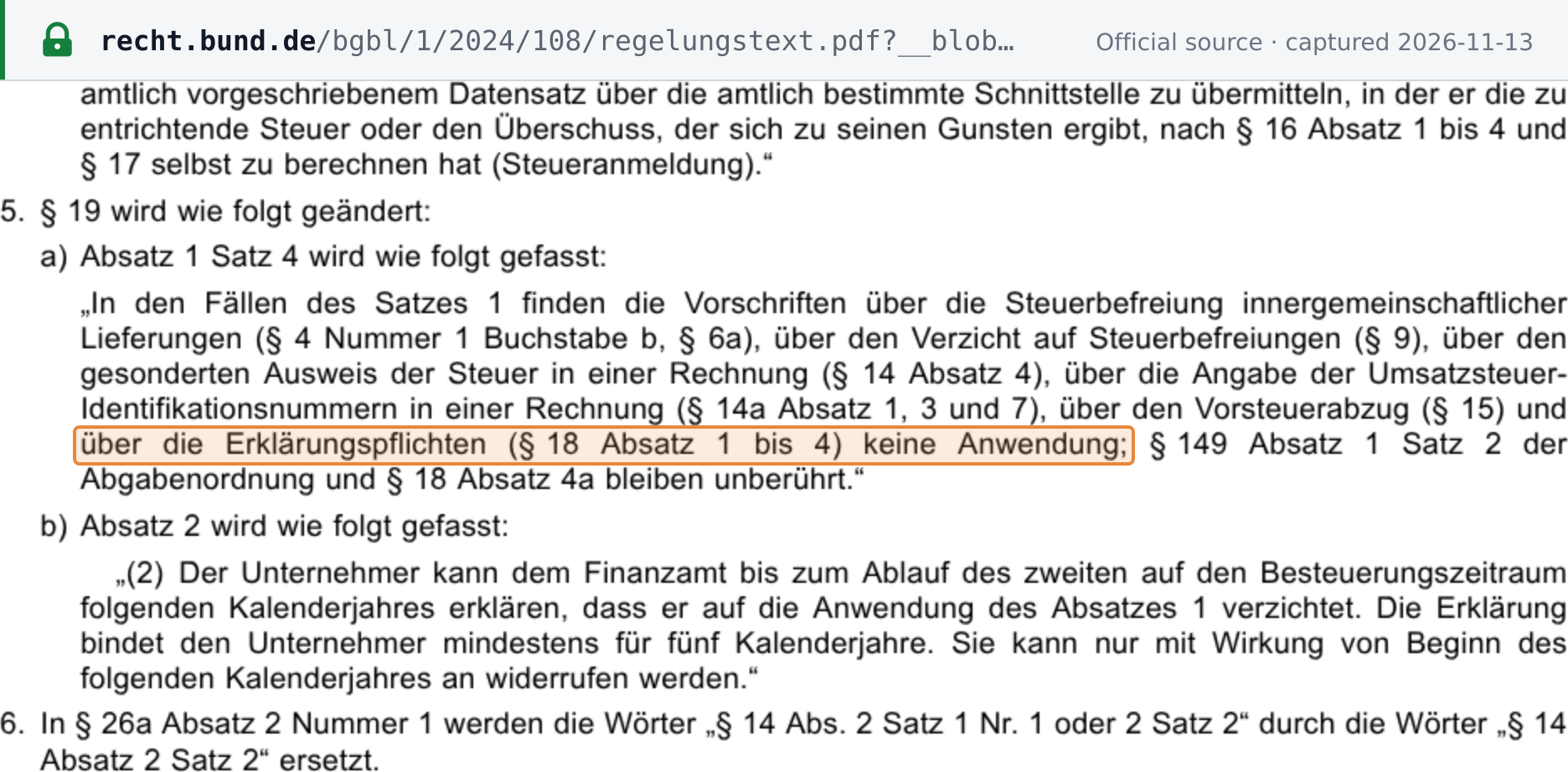 Source snapshot of the official page. Open full size ↗
Archived from the official distribution · BGBl. 2024 I Nr. 108, Wachstumschancengesetz vom 27. März 2024, ausgegeben am 27. März 2024; Artikel 23 Nummer 4 Buchstabe c, Nummer 5 und 7 (pages 24–25), Artikel 35 Absatz 6 (page 35) · www.recht.bund.de