Hungary rewrites the construction reverse-charge declaration rule from 1 January 2024
This page records one dated change. For the rules in Hungary as they stand today, see the Hungary guide →
- Jurisdiction
- Hungary
- Tax
- VAT
- Change type
- Compliance
- Status
- In force
- Impact
- FYI
- Announced
- 30 November 2023
- Effective
- 1 January 2024
- Authority
- Magyar Közlöny (Official Gazette of Hungary)
- Verified
- Fetched from official source · high confidence
Hungarian VAT-registered contractors, subcontractors and their taxable customers on construction or assembly work on real estate that requires an official permit or notification.
No action — monitoring only.
Act LXXXIII of 2023 (promulgated 30 November 2023) rewrote the domestic reverse charge for construction and assembly work on real estate (Áfa tv. s.142(1)(b)) from 1 January 2024. The taxable customer must still declare in advance and in writing to the supplier that the work requires an official permit or notification. If the permit or notification relates to the supplier's own work on the property (for example a subcontractor that holds the permit), the declaration falls on the supplier, towards the taxable customer. The scope wording was also restated as creation, extension, conversion, demolition or change of use of real estate.
What changed in detail
Section 142(1)(b) of the Hungarian VAT Act (Act CXXVII of 2007, Áfa tv.) applies the domestic reverse charge to construction and assembly work supplied as a service on real estate. Act LXXXIII of 2023 on the amendment of certain tax laws, promulgated in Magyar Közlöny on 30 November 2023, restated point (b) by its section 36 with effect from 1 January 2024.
Under the restated text the reverse charge covers construction, assembly and other installation work aimed at the creation, extension, conversion, demolition or change of use of real estate (together, “activity relating to real estate”), provided that the activity requires an official permit or a notification to an authority.
The declaration rule was rewritten. As before, the taxable customer must declare in advance and in writing to the supplier that the work is permit- or notification-bound. New is the second limb: where the permit or notification relates to the real-estate activity carried out by the supplier, the declaration falls on the supplier, who gives it to the taxable customer. The consolidated Áfa tv. on njt.jog.gov.hu shows point (b) in this form, with a footnote recording that its text was set by section 36 of Act LXXXIII of 2023.
What it means
The rule is in force and unchanged as of November 2026. It fixes a practical gap in subcontracting chains: a subcontractor’s customer is often another contractor that does not hold the building permit and cannot honestly declare what it requires, while the party carrying out the permitted work knows. Getting the declaration wrong is not cosmetic, because it decides whether the supplier invoices VAT or the customer self-assesses it. Contract templates and onboarding forms for construction work should state which party gives the declaration and keep it on file before the first invoice.
Proof
amelyről a szolgáltatás adóalany igénybevevője előzetesen és írásban köteles nyilatkozni a szolgáltatás nyújtójának, azzal, hogy ha a hatósági engedély vagy hatósághoz történő bejelentés a szolgáltatásnyújtó által végzett, ingatlanra vonatkozó tevékenységhez kapcsolódik, a nyilatkozattétel az utóbbit terheli a szolgáltatás adóalany igénybevevője feléabout which the taxable recipient of the service must make a prior written declaration to the supplier, provided that, where the official permit or notification relates to the real-estate activity carried out by the supplier, the declaration falls on the latter, towards the taxable recipient of the service
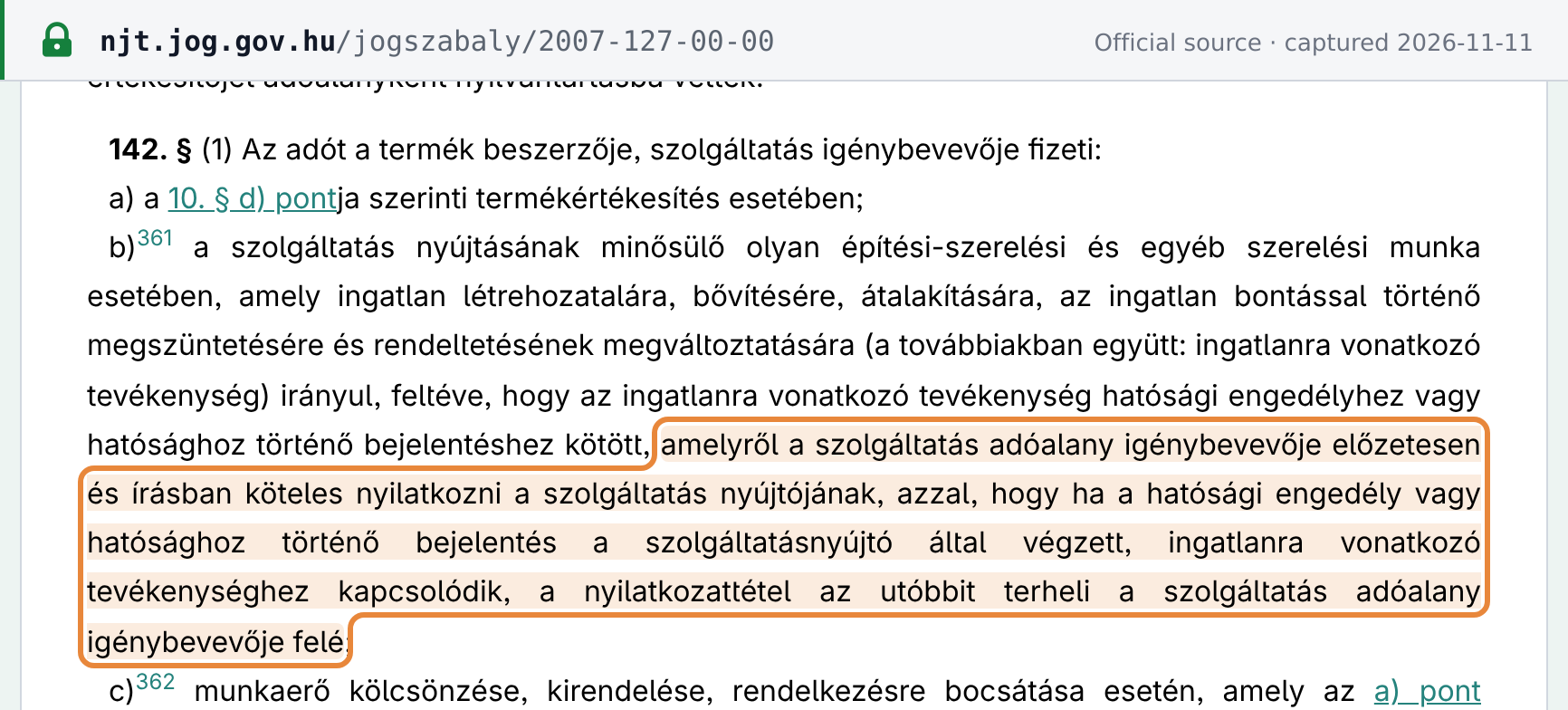 Source snapshot of the official page. Open full size ↗