Hungary implements the EU cross-border SME VAT exemption scheme from 1 January 2025
This page records one dated change. For the rules in Hungary as they stand today, see the Hungary guide →
- Jurisdiction
- Hungary
- Tax
- VAT
- Change type
- Registration
- Status
- In force
- Impact
- FYI
- Announced
- 30 November 2023
- Effective
- 1 January 2025
- Authority
- NAV (Nemzeti Adó- és Vámhivatal / National Tax and Customs Administration of Hungary)
- Verified
- Fetched from official source · high confidence
Small businesses established in Hungary or another EU member state with EU-wide annual turnover up to EUR 100,000; businesses established outside the EU are excluded.
No action — monitoring only.
Act LXXXIII of 2023 (promulgated 30 November 2023) transposed Council Directive (EU) 2020/285 by inserting ss.195/A-195/K into the Hungarian VAT Act from 1 January 2025. A Hungarian-established business may opt for the small-business exemption in other member states if its EU-wide turnover did not exceed EUR 100,000 in the previous or current year and its turnover in each such state stays under that state's threshold; it files and reports quarterly through NAV. A business established in another member state may opt for the Hungarian exemption (subject to the EUR 100,000 EU cap), through its home-state authority and the EX identification number, without registering for VAT in Hungary.
What changed in detail
Act LXXXIII of 2023 on the amendment of certain tax laws, promulgated in Magyar Közlöny on 30 November 2023, transposed Council Directive (EU) 2020/285 into the Hungarian VAT Act (Act CXXVII of 2007). It inserted sections 195/A to 195/K into Chapter XIII (subjective exemption for small businesses), effective 1 January 2025.
Before 2025 a small business could use the exemption only in the member state where it was established; anywhere else it had to register and account for VAT. From 2025 there are two directions:
- Outbound (ss.195/A–195/F): a business established in Hungary may opt for the small-business exemption in other member states that offer one, provided its turnover in each such state stays under that state’s threshold and its EU-wide turnover does not exceed EUR 100,000 in the previous or current year. It registers and files quarterly reports through NAV.
- Inbound (ss.195/G–195/K): a business established in another member state may opt for the Hungarian exemption for its Hungarian supplies, subject to the same EUR 100,000 cap, through its home-state authority using an EX identification number, without registering for VAT in Hungary.
Businesses established outside the EU cannot opt for the exemption in Hungary or elsewhere in the EU, even with a permanent establishment there.
What it means
The scheme is in force across the EU and is a lasting change, not a transition. For a Hungarian micro-business selling into neighbouring states it can replace several foreign VAT registrations with one quarterly report to NAV, but the EUR 100,000 EU-wide cap is a hard ceiling: crossing it ends the cross-border exemption everywhere. Inbound sellers must also stay under Hungary’s own domestic threshold, which has risen since the scheme began — HUF 20 million in 2026 (Hungary raises the threshold to HUF 20 million).
Proof
will be implemented on 1 January 2025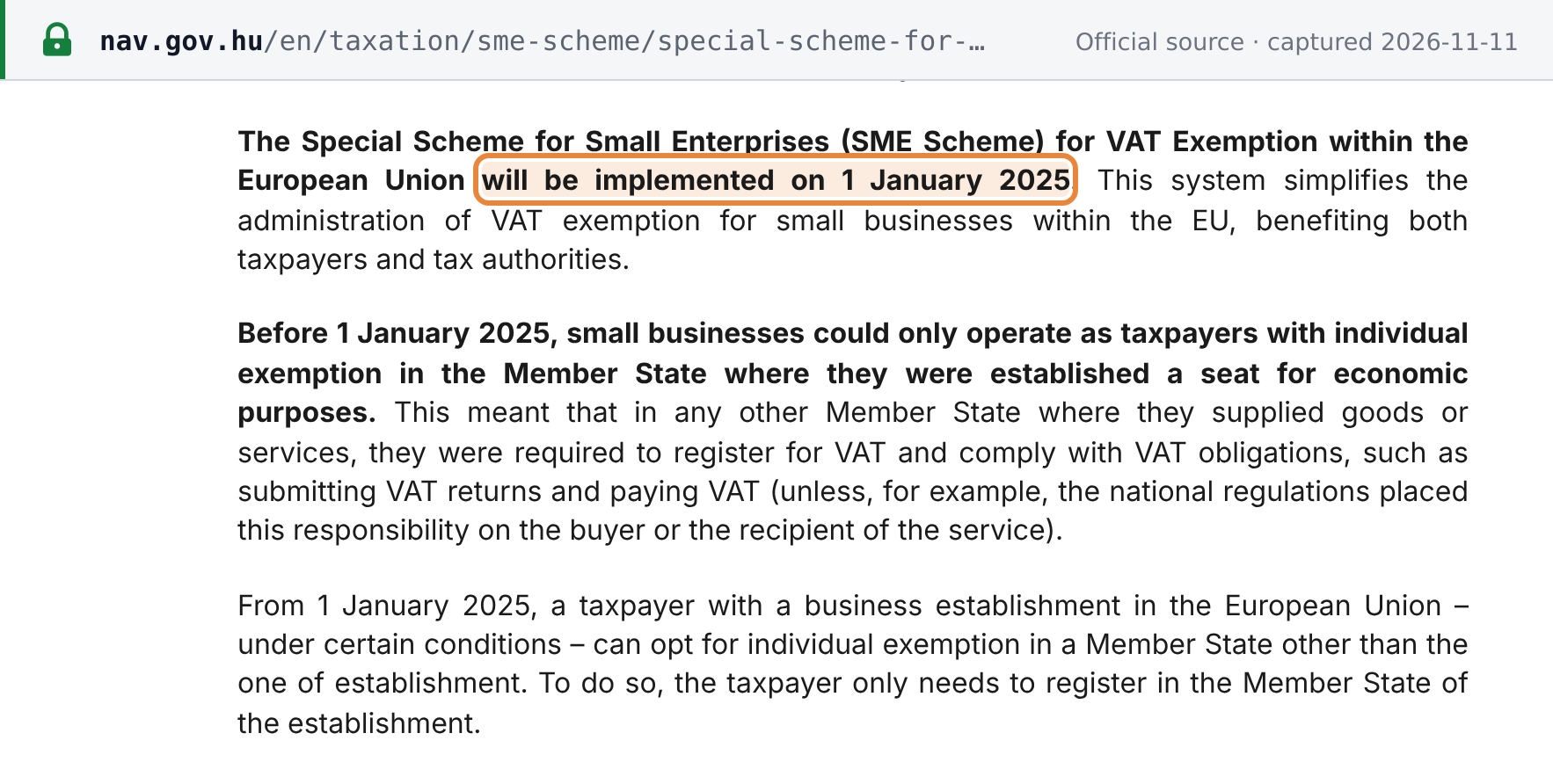 Source snapshot of the official page. Open full size ↗