India bars taxpayers with AATO above Rs 100 crore from reporting e-invoices more than 30 days old
This page records one dated change. For the rules in India as they stand today, see the India guide →
- Jurisdiction
- India
- Tax
- GST
- Change type
- E-invoicing
- Status
- In force
- Impact
- FYI
- Announced
- 1 November 2023
- Effective
- 1 November 2023
- Authority
- GSTN (Goods and Services Tax Network)
- Verified
- Fetched from official source · high confidence
GST taxpayers with aggregate annual turnover (AATO) greater than Rs 100 crore that generate IRNs for invoices, credit notes or debit notes.
No action — monitoring only. Superseded in scope by the Rs 10 crore extension from 1 April 2025: report e-invoices to the IRP within 30 days of the document date.
From 1 November 2023 (per the GSTN advisory of 13 September 2023 on the time limit for reporting invoices on the IRP), taxpayers with aggregate annual turnover (AATO) greater than Rs 100 crore cannot report invoices, credit notes or debit notes to the Invoice Registration Portal more than 30 days after the document date; the IRPs reject late reporting, so no IRN can be generated. The limit was extended to taxpayers with AATO of Rs 10 crore and above from 1 April 2025.
What changed in detail
A GSTN advisory, “Time limit for Reporting Invoices on the IRP Portal” (portal update of 13 September 2023), imposed a time limit on reporting old invoices on the e-invoice Invoice Registration Portals (IRPs) for taxpayers with an aggregate annual turnover (AATO) greater than Rs 100 crore. Taxpayers in that category may not report a document that is more than 30 days old on the date of reporting.
The restriction covers every document type for which an IRN is generated: invoices, credit notes and debit notes. The advisory’s example: an invoice dated 1 November 2023 cannot be reported after 30 November 2023. The validation built into the IRPs disallows reporting after the 30-day window.
To give taxpayers time to change their systems, the limit applied from 1 November 2023. The advisory stated that taxpayers with AATO below Rs 100 crore faced no such restriction “as of now”. The GST Council Secretariat reproduced the advisory in its September 2023 newsletter, which is the source captured here.
What it means
The rule is still in force, but its scope is wider now. A second GSTN advisory, of 5 November 2024, lowered the threshold to AATO of Rs 10 crore and above from 1 April 2025, keeping the same 30-day window. Read the two together: the 2023 advisory is the origin of the limit, and the 2024 one sets today’s population.
The limit is enforced by the portal, not by a penalty notice. A document reported late gets no IRN, and where an e-invoice is required, a document without an IRN is not a valid invoice. Businesses that batch credit notes or report invoices long after their date are the ones exposed.
Proof
taxpayers in this category will not be allowed to report invoices older than 30 days on the date of reporting.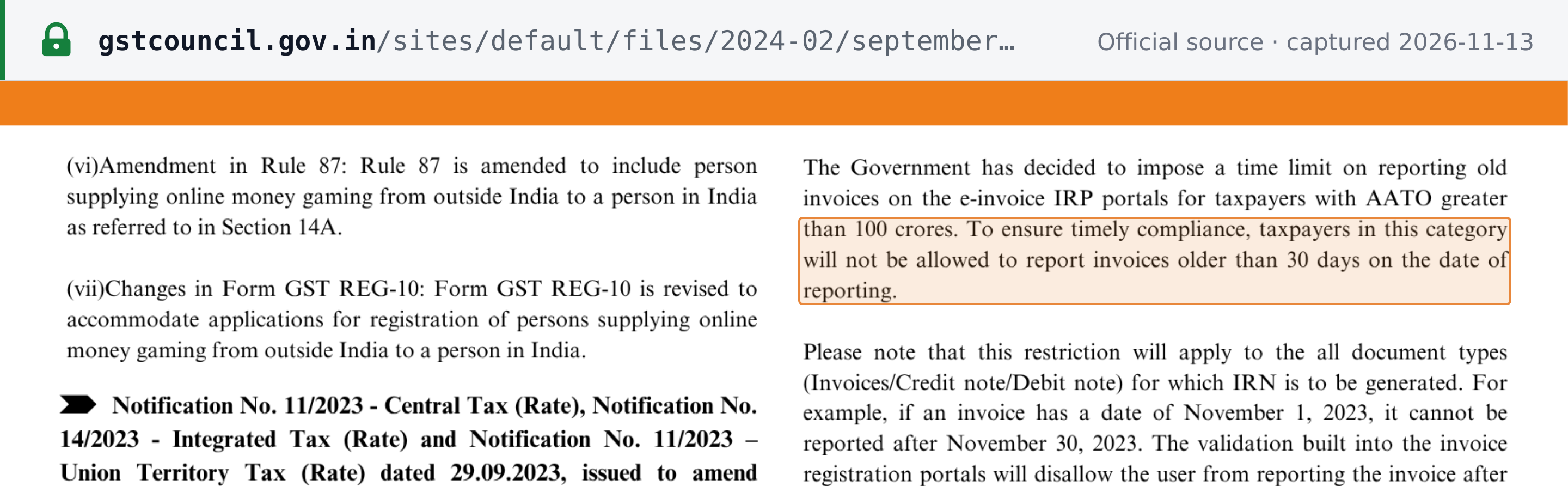 Source snapshot of the official page. Open full size ↗
Archived from the official distribution · GST Council Secretariat Newsletter, September 2023 (Advisory: Time limit for Reporting Invoices on the IRP Portal, portal update 13.09.2023) · gstcouncil.gov.in