Netherlands lets businesses with up to EUR 2,200 turnover use the KOR without notifying the tax office from 2025
This page records one dated change. For the rules in Netherlands as they stand today, see the Netherlands guide →
- Jurisdiction
- Netherlands
- Tax
- VAT
- Change type
- Threshold
- Status
- In force
- Impact
- FYI
- Announced
- 24 December 2024
- Effective
- 1 January 2025
- Instrument
- NL-MINISTERIAL-ORDER-Stcrt-2024-41523
- Authority
- Staatscourant van het Koninkrijk der Nederlanden
- Verified
- Fetched from official source · high confidence
Netherlands-established entrepreneurs with annual Dutch turnover up to EUR 2,200 that are not registered or required to register for VAT and do not use a small-business exemption in another member state.
No action — monitoring only. Since 1 January 2025, very small NL-established businesses (Dutch turnover up to EUR 2,200, not VAT-registered) may use the KOR without notifying the Belastingdienst.
The Eindejaarsregeling 2024 (Regeling van 19 december 2024, Stcrt. 2024, 41523, published 24 December 2024), article VI part C, sets the amount in article 25b(1)(a) of the Wet op de omzetbelasting 1968 at EUR 2,200 with effect from 1 January 2025. A Netherlands-established entrepreneur whose annual Dutch turnover does not exceed EUR 2,200 may apply the small-business exemption (KOR) without notifying the tax inspector, provided it has not registered (and is not required to register) for VAT with the inspector or the Chamber of Commerce and does not use the small-business exemption in another member state.
What changed in detail
The Eindejaarsregeling 2024 (Regeling van 19 december 2024, Stcrt. 2024, 41523, published 24 December 2024), article VI, part C, replaces article 25 of the Uitvoeringsbeschikking omzetbelasting 1968 with a single sentence: the amount referred to in article 25b(1)(a) of the Wet op de omzetbelasting 1968 is EUR 2,200. It applies from 1 January 2025.
Article 25b was inserted by the Wet implementatie Richtlijn kleineondernemersregeling (Stb. 2023, 278), which rebuilt the small-business scheme (kleineondernemersregeling, KOR) from 1 January 2025 but left this amount to ministerial order. Under article 25b, a Netherlands-established entrepreneur may apply the KOR without notifying the tax inspector if:
- its annual turnover in the Netherlands does not exceed the amount set by order, now EUR 2,200;
- it has not registered, and is not required to register, for VAT with the inspector or the Chamber of Commerce;
- it does not use the small-business exemption in another member state.
Article VI, part A, updates the reference in article 1 of the Uitvoeringsbeschikking to the new article 25b. The general KOR threshold of EUR 20,000 is set in the Act itself and is not changed by this order.
What it means
The EUR 2,200 route has applied since 1 January 2025 and still applies in November 2026. The explanatory note calls it a registration threshold: individuals with very small business income no longer have to notify the Belastingdienst just to stay exempt.
It is a narrow carve-out, not a new threshold. Above EUR 2,200, or once registered, the ordinary KOR rules from the 2025 reform apply: notification, the EUR 20,000 Dutch turnover limit and, for EU businesses, the EUR 100,000 EU-wide limit.
Proof
Het bedrag, bedoeld in artikel 25b, eerste lid, onderdeel a, van de wet, bedraagt € 2.200.The amount referred to in Article 25b(1)(a) of the Act is EUR 2,200.
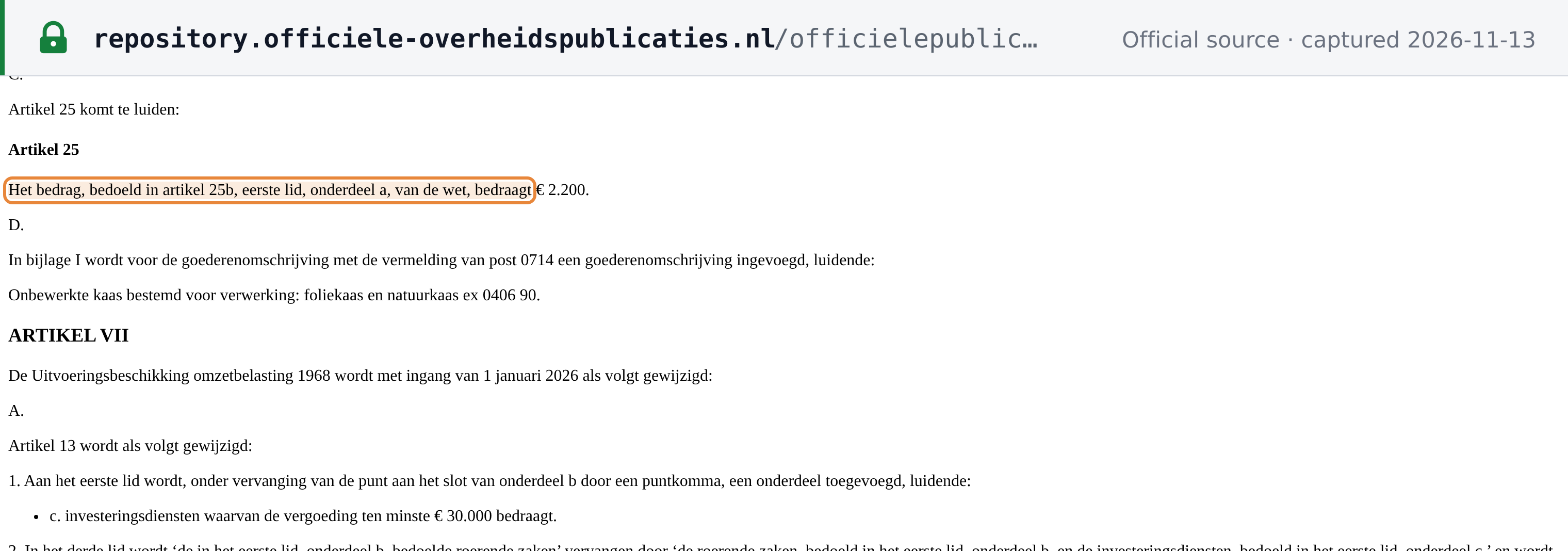 Source snapshot of the official page. Open full size ↗
Archived from the official distribution · Staatscourant 2024, 41523 (authentic PDF): Regeling van 19 december 2024 (Eindejaarsregeling 2024), published 24 December 2024 · repository.officiele-overheidspublicaties.nl