Philippines applies 12% VAT to digital services, including those supplied by non-resident providers (RA 12023)
This page records one dated change. For the rules in Philippines as they stand today, see the Philippines guide →
- Jurisdiction
- Philippines
- Tax
- VAT
- Change type
- Digital services
- Status
- In force
- Impact
- FYI
- Announced
- 2 October 2024
- Effective
- 18 October 2024
- Authority
- Congress of the Philippines
- Verified
- Fetched from official source · medium confidence
Resident and non-resident digital service providers whose services are consumed in the Philippines, and online marketplaces through which non-resident providers sell to consumers.
No action — VAT on digital services in force since June 2025; monitoring only.
Republic Act No. 12023 (VAT on Digital Services Act), signed by President Marcos on 2 October 2024 and published in the Official Gazette on 3 October 2024, subjects digital services consumed or used in the Philippines to 12% VAT regardless of whether the provider is resident or non-resident. Non-resident digital service providers (NRDSPs) must register with the BIR's VAT on Digital Services (VDS) portal and collect and remit VAT; resident online marketplaces are treated as the supplier for B2C sales by NRDSPs and carry the VAT liability. The law took effect 18 October 2024; compliance obligations for NRDSPs commenced 1 June 2025 per implementing Revenue Regulations N° 03-2025.
What changed in detail
Republic Act No. 12023 amends the National Internal Revenue Code (NIRC) of 1997 to bring digital services expressly into VAT. The signed enrolled copy shows it was approved on 2 October 2024.
- Section 105 now names persons who render digital services among those liable to VAT. Digital services delivered by non-resident digital service providers (NRDSPs) are considered performed in the Philippines if they are consumed there.
- Section 108(A) levies 12% VAT on gross sales from the sale or exchange of services, “including digital services”.
- NRDSPs must register for VAT and remit it on their sales to consumers. Under new Section 108-B, a VAT-registered NRDSP that is an online marketplace remits the VAT on non-resident sellers’ sales through its platform. Resident online marketplaces withhold and remit the VAT under Revenue Regulations No. 3-2025, section 6(A), not under the Act itself.
- Under Section 14, NRDSPs become subject to VAT 120 days after the implementing regulations take effect.
- Under Section 18, the Act takes effect 15 days after publication. Publication in the Official Gazette on 3 October 2024 is reported, which gives 18 October 2024. Neither date is printed in the enrolled text.
What it means
The law is in force, and the VAT has been collected since 2025. Revenue Regulations No. 3-2025 set the clock: NRDSPs had to register through the VAT on Digital Services portal within 60 days of the regulations’ effectivity, and became liable after 120 days, reported as 1 June 2025.
The BIR has since clarified the scope. In June 2026, RMC No. 59-2026 said non-resident providers must register and file even where their supplies are VAT-exempt. It also said that in cross-border cost-sharing arrangements, the Philippine user withholds the VAT under the reverse charge.
Proof
There shall be levied, assessed and collected, a value-added tax equivalent to twelve percent (12%) of the gross sales derived from the sale or exchange of services, including digital services, and the use or lease of properties.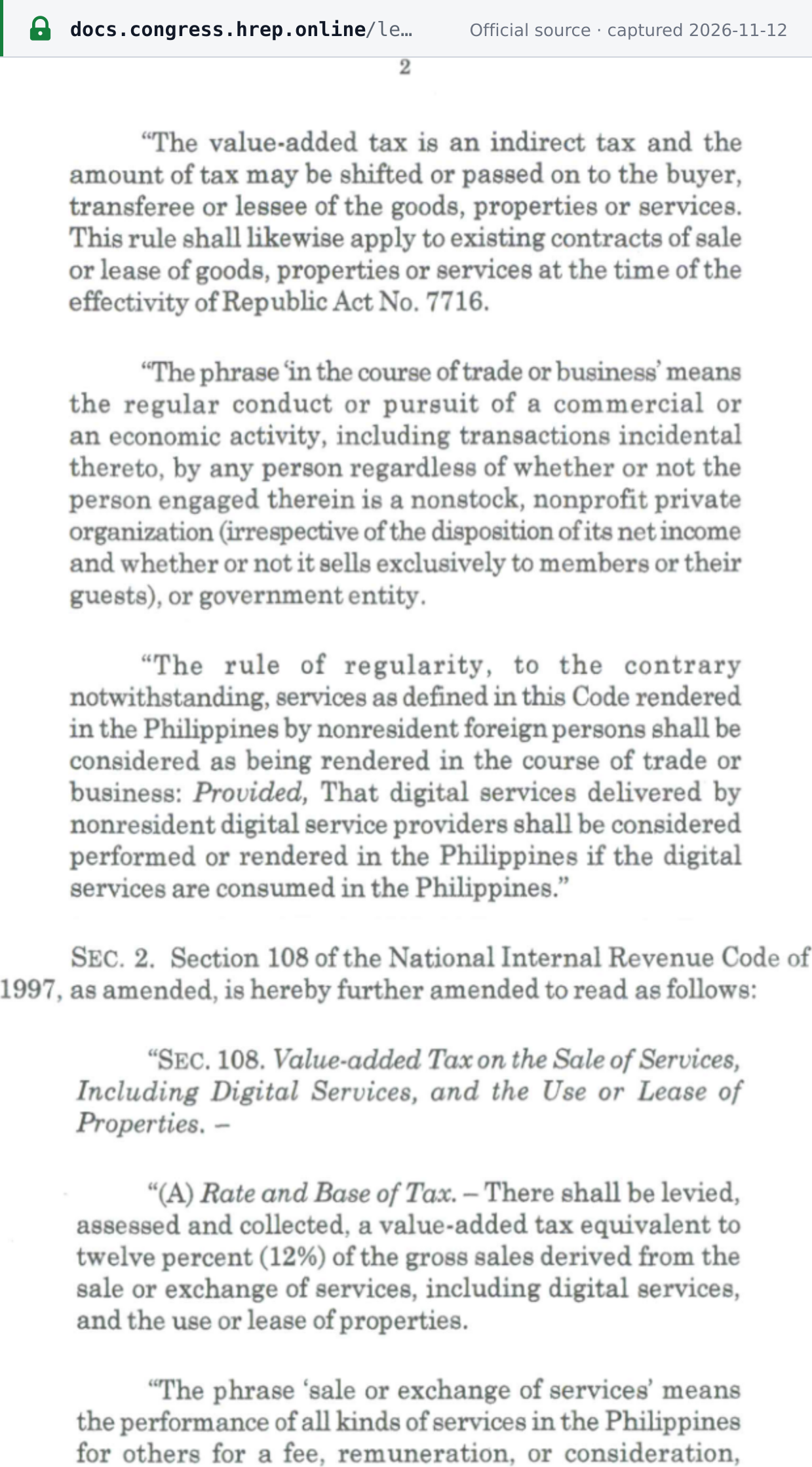 Source snapshot of the official page. Open full size ↗
Archived from the official distribution · Republic Act No. 12023 (H. No. 4122, S. No. 2528), enrolled signed copy, House of Representatives; approved 2 October 2024 · docs.congress.hrep.online