Philippines zero-rates local purchases "directly attributable" to exporters with 70% export sales (CREATE MORE Act, RA 12066)
This page records one dated change. For the rules in Philippines as they stand today, see the Philippines guide →
- Jurisdiction
- Philippines
- Tax
- VAT
- Change type
- Rate change
- Status
- In force
- Impact
- FYI
- Announced
- 8 November 2024
- Effective
- 27 November 2024
- Authority
- Congress of the Philippines
- Verified
- Fetched from official source · medium confidence
Export-oriented enterprises whose export sales are at least 70% of total annual production, their local suppliers of goods and services, and VAT refund claimants.
No action — in force since November 2024; RBEs subject to new eligibility rules. Monitoring only.
Republic Act No. 12066 (CREATE MORE Act), approved 8 November 2024 and effective 15 days after publication (27 November 2024 per trackers), amends the VAT rules for export-oriented enterprises. Local purchases of goods and services 'directly attributable' to the export activity of an enterprise whose export sales are at least 70% of total annual production are zero-rated, and imports under the same test are VAT-exempt. 'Directly attributable' expressly covers janitorial, security, financial, consultancy, marketing and promotion services and administrative services such as HR, legal and accounting. Input tax attributable to VAT-exempt sales is deductible from gross income. The Act also creates VAT refund centres in the BIR and BOC and risk-based processing of VAT refund claims. BIR circularised the law through RMC No. 135-2024.
What changed in detail
Republic Act No. 12066, the CREATE MORE Act, was approved on 8 November 2024, as the signature page of the enrolled copy shows. Under Section 35 it takes effect 15 days after publication. The reported effective date is 27 November 2024; the publication date is not printed in the Act.
Its VAT changes to the NIRC:
- Zero-rating (Secs. 106(A)(2)(a)(3) and 108(B)(5)): local sales of goods and services to an export-oriented enterprise whose export sales are at least 70% of total annual production for the preceding taxable year are zero-rated, provided they are directly attributable to its export activity. The Export Marketing Bureau of the Department of Trade and Industry checks the threshold. An enterprise that misses it loses zero-rating on local purchases in the following year.
- “Directly attributable” covers goods and services incidental to and reasonably necessary for the export activity. It expressly includes janitorial, security, financial, consultancy, marketing and promotion services, and administrative services such as HR, legal and accounting.
- Imports (Sec. 109): imports by such enterprises are VAT-exempt under the same test.
- Input tax: input tax attributable to VAT-exempt sales is deductible from gross income.
- Refunds: VAT refund centres are set up in the BIR and the Bureau of Customs, and VAT refund claims are processed on a risk basis.
The BIR circularised the Act through RMC No. 135-2024.
What it means
These rules are in force. The definition settled a long-running dispute over which supplier services to exporters qualify for zero-rating. Exporters’ suppliers of security, cleaning, accounting and similar services can now zero-rate those sales, provided the buyer meets the 70% test. A supplier should keep evidence that the buyer qualifies.
The same Act amended NIRC Sections 237 and 237-A. RR No. 11-2025 builds the electronic invoicing mandate on those amendments, and RR No. 26-2025 extended its deadline to 31 December 2026.
Proof
For this purpose, ‘directly attributable’ shall refer to goods and services that are incidental to and reasonably necessary for the export activity of the export-oriented enterprise, including janitorial, security, financial, consultancy, marketing and promotion services, and services rendered for administrative operations such as human resources, legal, and accounting;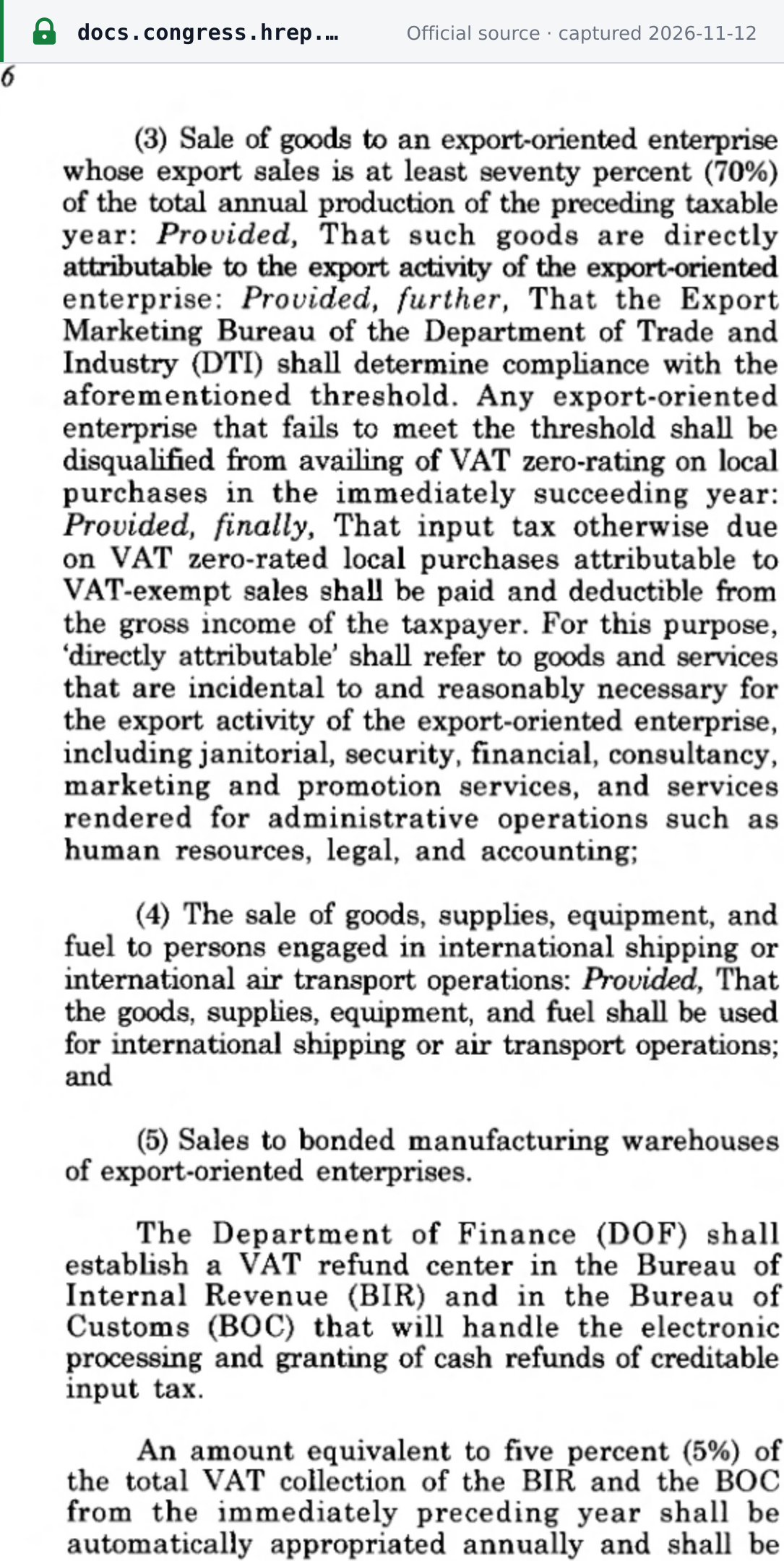 Source snapshot of the official page. Open full size ↗
Archived from the official distribution · Republic Act No. 12066 (CREATE MORE Act), enrolled signed copy, House of Representatives; approved 8 November 2024 (p. 53) · docs.congress.hrep.online