BIR mandates electronic invoicing for e-commerce, large taxpayers and CAS users (RR No. 11-2025)
This page records one dated change. For the rules in Philippines as they stand today, see the Philippines guide →
- Jurisdiction
- Philippines
- Tax
- VAT
- Change type
- E-invoicing
- Status
- In force
- Impact
- FYI
- Announced
- 26 February 2025
- Effective
- 14 March 2025
- Authority
- Bureau of Internal Revenue (BIR), Philippines
- Verified
- Fetched from official source · medium confidence
E-commerce and internet-transaction taxpayers (micro exempt), Large Taxpayers Service taxpayers, large taxpayers under the Ease of Paying Taxes Act, and users of CAS, CBA or other invoicing software.
No action — EIS mandate extended to 31 December 2026 per RR 26-2025 (shipped separately). Monitoring only.
BIR Revenue Regulations No. 11-2025 (signed 26 February 2025; effective 15 days after publication, 14 March 2025 per trackers) implements Sections 237 and 237-A of the Tax Code, as amended by the CREATE MORE Act (RA 12066). It mandates structured electronic invoices for: (1) e-commerce/internet-transaction taxpayers; (2) Large Taxpayers Service taxpayers; (3) large taxpayers under the Ease of Paying Taxes Act; and (4) CAS/CBA and other invoicing-software users. Exporters, RBEs with incentives, and POS users follow once the BIR's system is established. Groups (1)–(3) got one year from effectivity (to 14 March 2026), later extended to 31 December 2026 by RR No. 26-2025. Micro taxpayers are exempt, and an additional deduction of 100% (micro/small) or 50% (medium/large) of e-sales-reporting set-up costs is allowed.
What changed in detail
Revenue Regulations No. 11-2025 implement NIRC Sections 237 and 237-A, as amended by the CREATE MORE Act (RA 12066). The document is dated 25 February 2025, Secretary Recto signed it on 26 February 2025, and the BIR records division stamped it on 27 February 2025.
Covered taxpayers (Sec. 3(A)). The following must issue electronic invoices:
- taxpayers engaged in e-commerce or internet transactions;
- taxpayers under the Large Taxpayers Service;
- large taxpayers under the Ease of Paying Taxes Act;
- taxpayers using CAS, CBA or other invoicing software.
Exporters, RBEs with incentives and POS users (Sec. 3(A)(5)), and the taxpayers in Sec. 3(B), must comply once the BIR has a system able to store and process the data. A separate RR will set that date.
Transition (Sec. 6). Groups (1) to (3) have one year from effectivity to begin issuing e-invoices. Group (4) gets no such period in the text.
Exemption and relief. Micro taxpayers are exempt (Sec. 4). An additional deduction is allowed for the set-up costs of electronic sales reporting: 100% of those costs for micro and small taxpayers, 50% for medium and large ones.
Effectivity (Sec. 9). The regulations take effect 15 days after publication in the Official Gazette or on the BIR website. The publication date is not printed, and the reported effectivity is 14 March 2025.
What it means
The one-year window did not hold. RR No. 26-2025 extended the transitory provision, so covered taxpayers now have until 31 December 2026 to start issuing e-invoices. CAS and invoicing-software users are within that extension as well. The head-office-and-branch coverage still comes from this RR, as a later record sets out.
With weeks to go, RMC No. 98-2026 requires a Permit to Issue electronic invoices, and EIS certification within six months of that permit. RMC No. 110-2026 sets the accreditation rules for e-invoicing service providers. Exporters and POS users are still waiting for the BIR system and their separate RR.
Proof
Taxpayers covered under Section 3(A)(1) to (3) have a period of one (1) year from the effectivity date of these Regulations to comply with the electronic invoicing requirements (issuance of electronic invoice).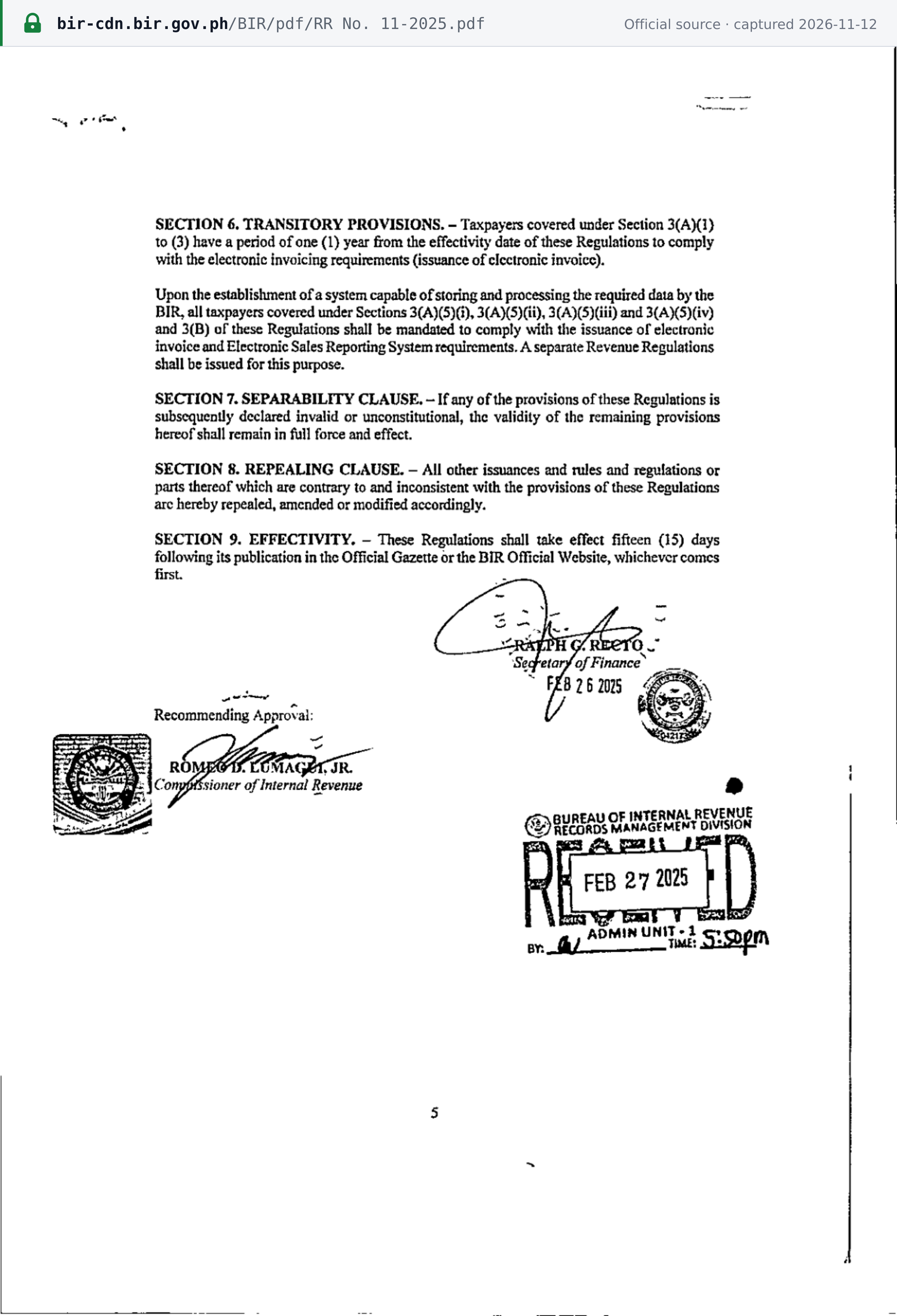 Source snapshot of the official page. Open full size ↗
Archived from the official distribution · Revenue Regulations No. 011-2025, Bureau of Internal Revenue, signed 26 February 2025, Sec. 6 (p. 5) · bir-cdn.bir.gov.ph