South Africa removes the VAT exit charge for persons deregistered only by the enterprise proviso (xiii)
This page records one dated change. For the rules in South Africa as they stand today, see the South Africa guide →
- Jurisdiction
- South Africa
- Tax
- VAT
- Change type
- Registration
- Status
- In force
- Impact
- FYI
- Announced
- 24 December 2024
- Effective
- 1 January 2025
- Instrument
- ZA-ACT-42-2024
- Authority
- Parliament of the Republic of South Africa
- Verified
- Fetched from official source · high confidence
Persons within paragraph (xiii) of the proviso to the VAT "enterprise" definition who paid VAT under section 7(1)(b), were registered or required to register, and ceased to be vendors solely because paragraph (xiii) was introduced.
Persons that ceased to be vendors solely because of paragraph (xiii) of the proviso to the 'enterprise' definition should confirm the section 8(2) exit charge does not apply to them from 1 January 2025.
Section 46(1)(b) of the Taxation Laws Amendment Act 42 of 2024 (Government Gazette 51826, 24 December 2024, assented 20 December 2024) adds paragraph (vii) to the proviso to section 8(2) of the VAT Act 89 of 1991: section 8(2) (the deemed output-tax supply on ceasing to be a vendor) does not apply to a person contemplated in paragraph (xiii) of the proviso to the 'enterprise' definition who paid tax under section 7(1)(b), was registered or required to be registered, and ceases to be a vendor solely because paragraph (xiii) was introduced. Although the Explanatory Memorandum proposed retroactive effect from 1 January 2023, the enacted Act brings paragraph (b) into operation on 1 January 2025 (s.46(3)); Act 5 of 2026 s.62 also moved s.46(2) to 1 January 2025.
What changed in detail
Section 46(1)(b) of the Taxation Laws Amendment Act 42 of 2024 (Government Gazette 51826, 24 December 2024; assented to on 20 December 2024) adds paragraph (vii) to the proviso to section 8(2) of the Value-Added Tax Act 89 of 1991.
Section 8(2) deems a vendor to supply its remaining goods, and so to account for output tax, when it ceases to be a vendor. The new paragraph switches that rule off for a person contemplated in paragraph (xiii) of the proviso to the “enterprise” definition in section 1(1) where the person:
- paid the tax under section 7(1)(b);
- was registered, or was required to be registered, under section 23; and
- ceases to be a vendor solely because paragraph (xiii) was introduced.
Under section 46(3), paragraph (b) comes into operation on 1 January 2025. The proposal had been for retroactive effect from 1 January 2023, but the enacted Act uses the 2025 date. Section 46(2) deemed paragraph (a) to have come into operation on 1 January 2023, and section 62 of the Taxation Laws Amendment Act 5 of 2026 later moved that date to 1 January 2025 as well.
What it means
The relief is in force. Paragraph (xiii) took certain non-resident suppliers out of the VAT “enterprise” definition, and on its own that would have triggered the section 8(2) exit charge when they deregistered. Paragraph (vii) means they do not pay output tax just for leaving a system the law took them out of.
The relief is narrow: all three conditions must be met, and the change in status must result solely from paragraph (xiii). Anyone who deregistered for another reason as well remains subject to the exit charge.
Proof
(3) Paragraph (b) of subsection (1) comes into operation on 1 January 2025.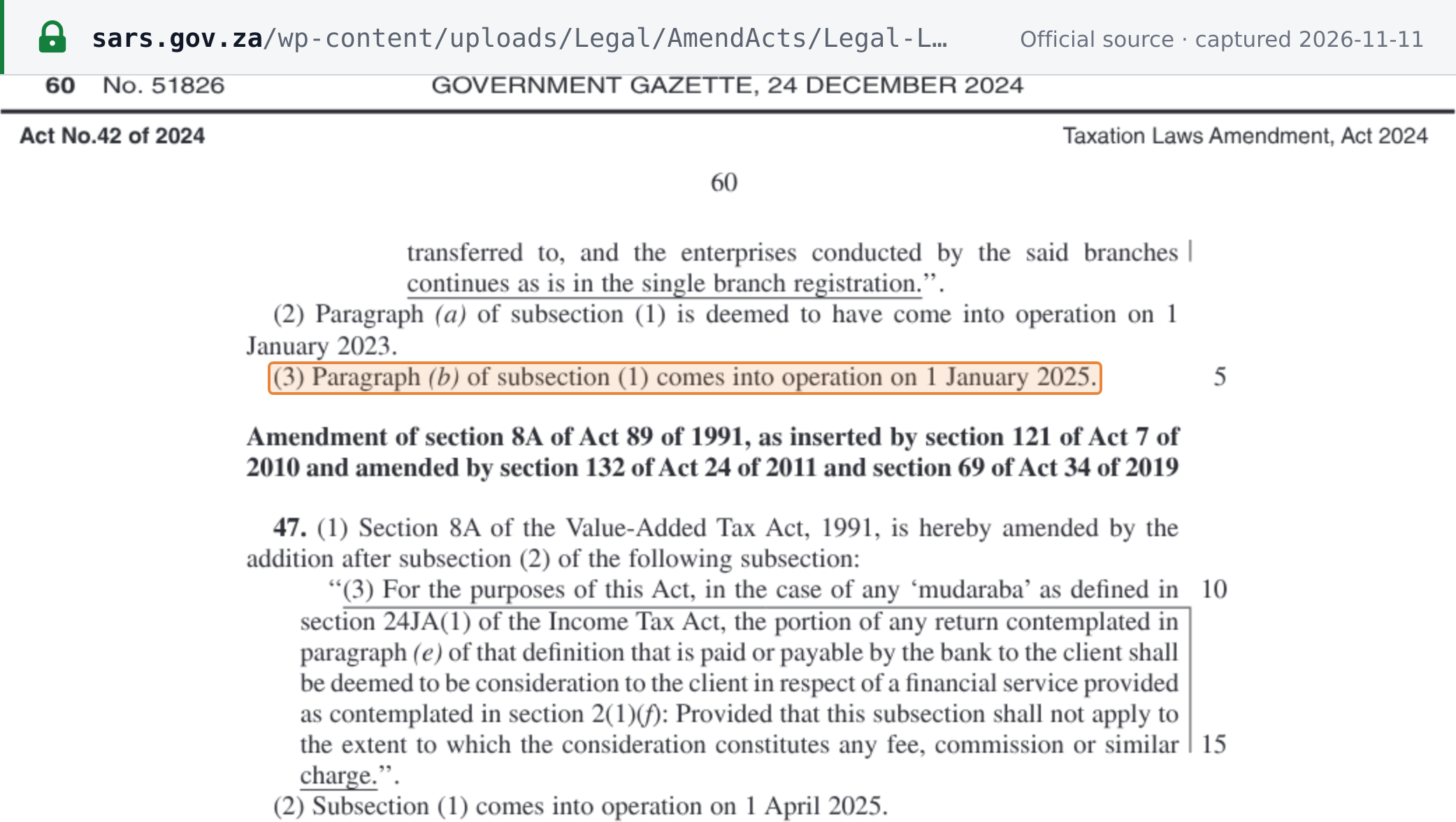 Source snapshot of the official page. Open full size ↗
Archived from the official distribution · Taxation Laws Amendment Act 42 of 2024, Government Gazette No. 51826, 24 December 2024 · www.sars.gov.za