Uganda exempts locally made electric vehicles, EV charging and ethanol cooking stoves from VAT from 1 July 2024
This page records one dated change. For the rules in Uganda as they stand today, see the Uganda guide →
- Jurisdiction
- Uganda
- Tax
- VAT
- Change type
- Update
- Status
- In force
- Impact
- FYI
- Announced
- 15 July 2024
- Effective
- 1 July 2024
- Authority
- Parliament of Uganda
- Verified
- Fetched from official source · high confidence
Ugandan manufacturers and sellers of locally made electric vehicles and EV frames and bodies, EV charging-equipment suppliers and charging-service operators, assemblers of ethanol cooking stoves, and suppliers relying on the energy-project exemption in paragraph (dda).
No action — monitoring only.
Uganda Value Added Tax (Amendment) Act, 2024 (effective 1 July 2024) amended the Second Schedule to exempt the supply of locally manufactured electric vehicles (sf), electric vehicle charging equipment or charging services (sg), and fuel-ethanol cooking stoves assembled in Uganda until 30 June 2028 (sh). The Act also repealed subparagraph (b) of the Second Schedule and amended paragraph (dda) to exclude goods and services used for personal and domestic use from the energy-projects exemption. First Schedule additions include African Reinsurance Corporation, Independent Regulatory Board of the East African Power Pool, and Islamic Cooperation for the Development of the Private Sector.
What changed in detail
Uganda’s Value Added Tax (Amendment) Act, 2024, assented to on 15 July 2024 and in force from 1 July 2024, amends both schedules of the Value Added Tax Act, Cap. 349.
Second Schedule (exempt supplies), section 7. In paragraph 1 the Act:
- repeals subparagraph (b);
- inserts (sf), the supply of a locally manufactured electric vehicle or of a locally fabricated EV frame and body; (sg), the supply of EV charging equipment or EV charging services; and (sh), the supply of fuel-ethanol cooking stoves assembled in Uganda, up to 30 June 2028;
- adds the word “safety” after “lifesaving gear” in (x);
- narrows the energy-projects exemption in (dda) so that it does not include goods and services used for personal and domestic use;
- adds item (viii) to subparagraph (pp): a person who manufactures EVs, electric batteries or EV charging equipment, or fabricates EV frames and bodies;
- repeals (ggg)(i).
First Schedule, section 6. Adds the African Reinsurance Corporation (Africa Re), the Independent Regulatory Board of the East African Power Pool, and the Islamic Cooperation for the Development of the Private Sector to the listed institutions.
What it means
The EV and charging exemptions carry no end date; the ethanol-stove exemption lapses after 30 June 2028 unless extended. Exempt is not zero-rated: suppliers of these items charge no VAT but cannot recover input VAT on their costs.
These items reflect the 2024 Act; the weekly feed records no later change to them. Uganda revisits the Second Schedule most years, so confirm the current consolidated schedule, by paragraph letter, before relying on any item.
Proof
“(sf) the supply of an electric vehicle locally manufactured or supply of frame and body of an electric vehicle locally fabricated; (sg) the supply of electric vehicle charging equipment or supply of charging services of an electric vehicle; (sh) the supply of cooking stoves, that use fuel ethanol, assembled in Uganda, up to 30th June, 2028;”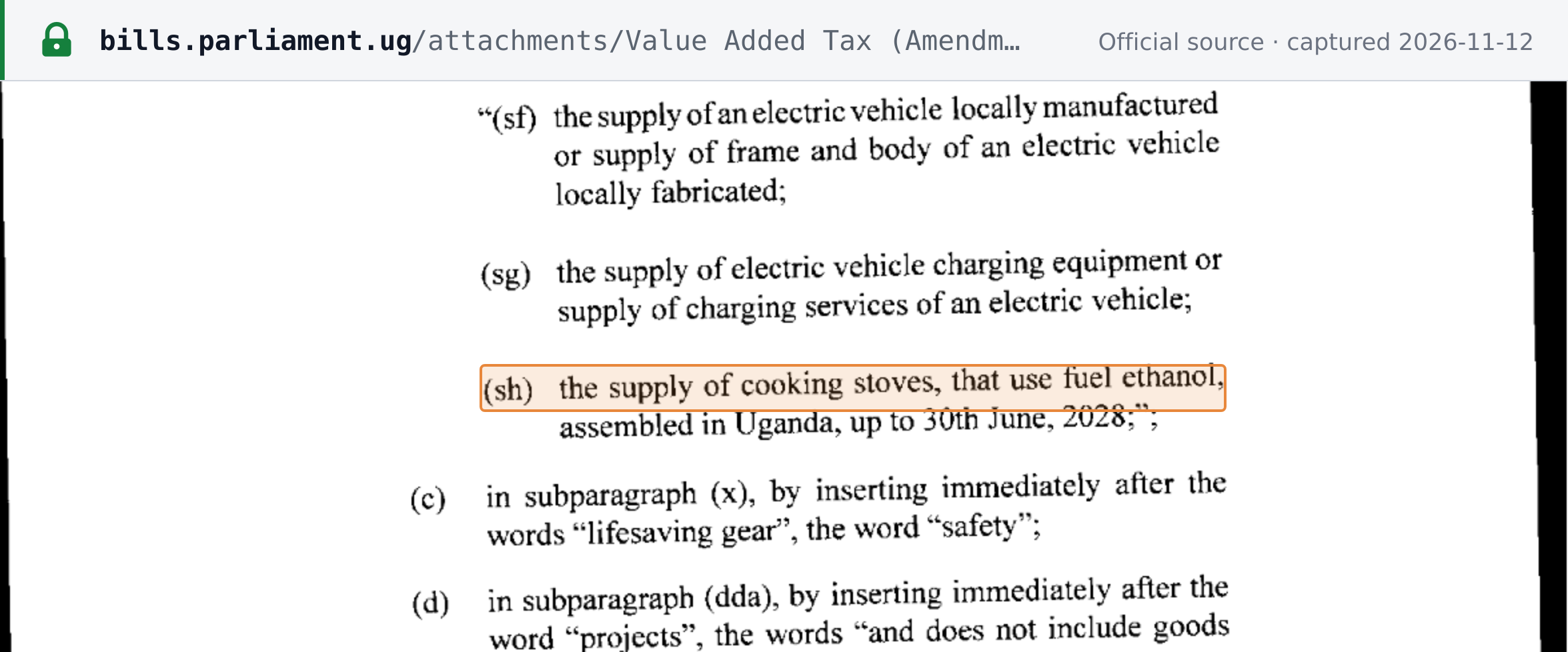 Source snapshot of the official page. Open full size ↗
Archived from the official distribution · The Value Added Tax (Amendment) Act, 2024 (Uganda), assented 15 July 2024; scanned authenticated copy published by the Parliament of Uganda · bills.parliament.ug