UK standard-rates electricity from public and workplace EV charge points from 1 November 2026 (Finance Bill 2026-27)
This change is proposed and is not law. The rules below describe what would change if it is adopted.
This page records one dated change. For the rules in United Kingdom as they stand today, see the United Kingdom guide →
- Jurisdiction
- United Kingdom
- Tax
- VAT
- Change type
- Rate change
- Status
- Proposed
- Impact
- Action required
- Announced
- 28 October 2026
- Effective
- 1 November 2026
- Authority
- HM Revenue & Customs
- Systems
- Tax engine, Invoicing, POS
- Verified
- Fetched from official source · high confidence
Operators of publicly accessible EV charge points, and employers or site owners supplying electricity through charge points accessible to employees and contractors at their workplace.
EV charge-point operators and employers with workplace chargers: charge 20% VAT on non-domestic charging from 1 November 2026.
Tax engineInvoicingPOS
HMRC's Revenue and Customs Brief 13 (2026) states that Finance Bill 2026-27 legislation provides that electricity supplied through publicly accessible electric vehicle charge points, and through charge points accessible to employees and contractors at their workplace, is not supplied for domestic use and so is standard-rated, applying from 1 November 2026.
What changed in detail
The government will introduce the legislation in Finance Bill 2026-27, which has not yet received Royal Assent; HMRC’s Revenue and Customs Brief 13 (2026) states that the legislation takes effect on 1 November 2026. The Budget 2026 Overview of Tax Legislation and Rates (28 October 2026) states that the government will legislate to clarify that electricity supplied through publicly accessible electric vehicle charging points is standard rated for VAT.
HMRC’s Revenue and Customs Brief 13 (2026), published the same day, sets out that the following supplies of electricity are not for domestic use for VAT purposes:
- electricity supplied through publicly accessible EV charging points; and
- electricity supplied through charging points accessible to employees and contractors at their workplace.
HMRC’s brief says these supplies are standard rated unless supplied to a charity and used for non-business purposes. The same supplies are also treated as not for domestic use for Climate Change Levy. The brief says the legislation gives statutory effect to HMRC’s longstanding policy, follows the First-tier Tribunal decision in Charge My Street Ltd, and applies from 1 November 2026.
Electricity used to charge a vehicle as part of a general supply to a home, or through a stand-alone charger for private residential use at a dwelling, may still qualify for the domestic relief.
What it means
This closes the argument opened by Charge My Street: public charge-point operators cannot treat their supplies as domestic-rate electricity. The change that catches people is workplace charging, which is now expressly outside the relief too. Charge-point operators and employers running workplace chargers should be charging 20% VAT, and accounting for Climate Change Levy, on supplies from 1 November 2026. Home chargers are unaffected.
Proof
These supplies will be standard rated unless supplied to a charity and used for non-business purposes.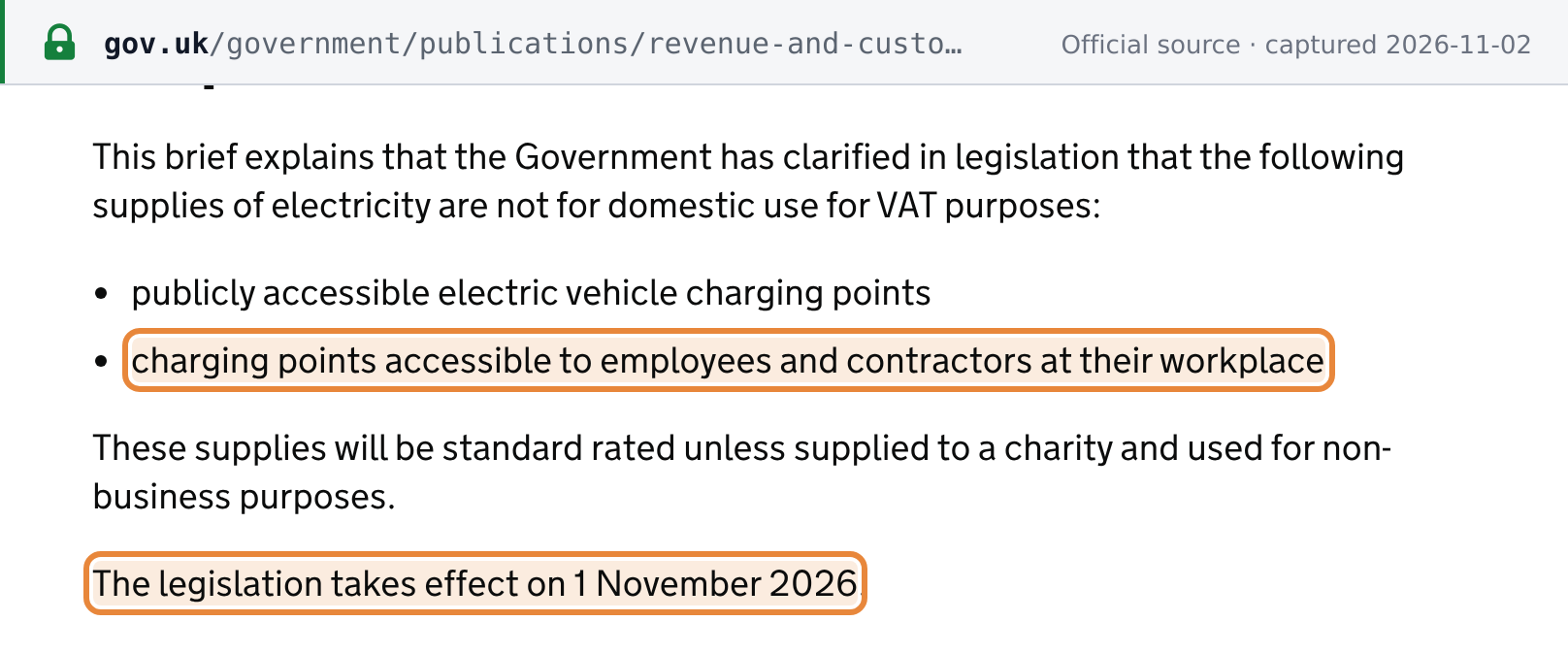 Source snapshot of the official page. Open full size ↗
The legislation takes effect on 1 November 2026. Source snapshot of the official page. Open full size ↗As announced at Budget 2026, the government will introduce legislation in Finance Bill 2026-27 to clarify that electricity supplied through publicly accessible electric vehicle charging points is standard rated for VAT. It also specifies that publicly accessible electric vehicle charging points are not considered a domestic use for the purpose of Climate Change Levy. The changes will take effect from 1 November 2026.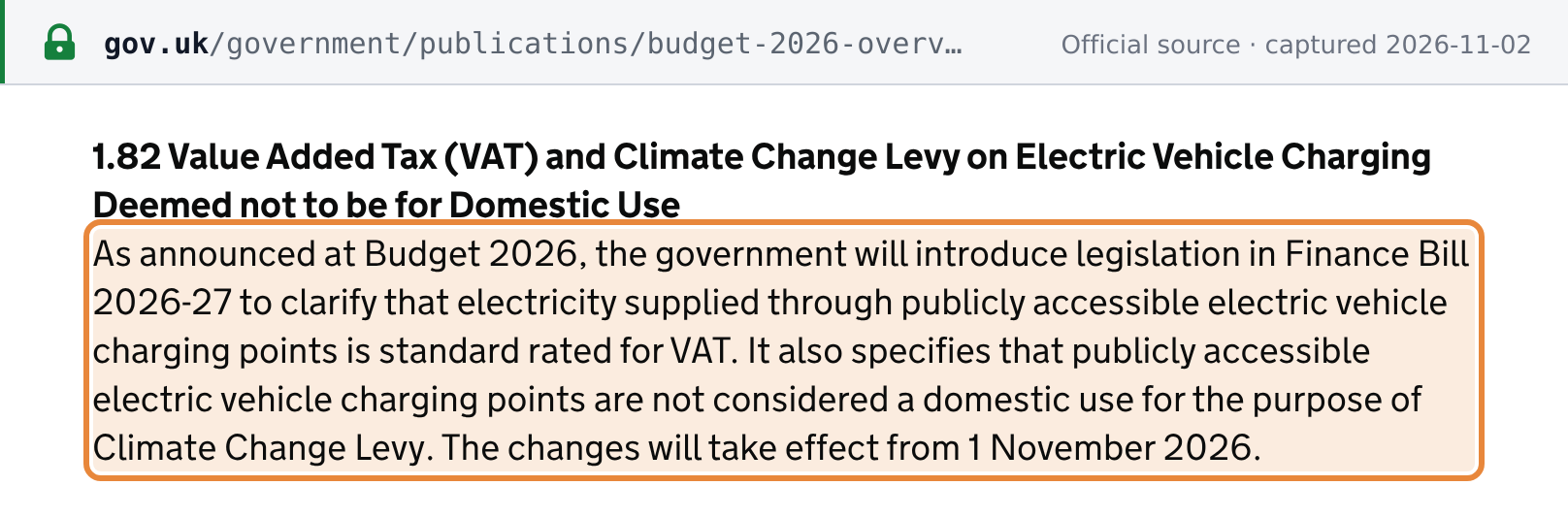 Source snapshot of the official page. Open full size ↗