UK publishes its e-invoicing roadmap for 1 April 2029 and plans Finance Bill powers to require e-invoices
This change is proposed and is not law. The rules below describe what would change if it is adopted.
This page records one dated change. For the rules in United Kingdom as they stand today, see the United Kingdom guide →
- Jurisdiction
- United Kingdom
- Tax
- VAT
- Change type
- E-invoicing
- Status
- Proposed
- Impact
- Plan ahead
- Announced
- 28 October 2026
- Effective
- 1 April 2029
- Authority
- HM Revenue & Customs
- Systems
- Invoicing, ERP
- Verified
- Fetched from official source · high confidence
VAT-registered persons, and any person (including public bodies that are not VAT registered) who must receive a VAT invoice to recover input tax.
VAT-registered businesses: plan Peppol-capable invoicing for the 1 April 2029 requirement.
InvoicingERP
At Budget 2026 the UK government published an e-invoicing implementation roadmap for e-invoicing requirements for VAT-registered persons, including public bodies, from 1 April 2029, and will legislate in Finance Bill 2026-27 for the enabling powers. A related Finance Bill measure gives HMRC functions to prepare to become the UK Peppol Authority; when HMRC takes on that role is not yet determined.
What changed in detail
This is a proposal, not yet law. At Budget 2026 (28 October 2026) the UK government published an e-invoicing implementation roadmap setting out the key decisions, products and delivery milestones for introducing e-invoicing requirements for VAT-registered persons, including public bodies, from 1 April 2029.
The government will introduce legislation in Finance Bill 2026-27 to give HMRC enabling powers. According to HMRC’s tax information and impact note, the Bill will amend Schedule 11 to the VAT Act 1994 so that HMRC can make regulations prescribing when a VAT invoice must be in electronic format, the form and structure of the invoice, and the technology, systems and networks to be used, with power to provide exemptions and transitional provision. The detailed technical requirements will follow in secondary legislation. The enabling powers come into force at Royal Assent; the requirements have effect from April 2029.
The same measure would give HMRC functions to prepare to become the UK Peppol Authority. The note states that it is not yet determined when HMRC will become the Authority, which currently sits within Supply Chain Coordination Limited.
What it means
The 2029 date now has a legal route: primary powers in this Finance Bill, then regulations carrying the actual rules. What businesses still lack is the detail (scope, exemptions, format), which arrives with the secondary legislation, so this is a planning year rather than a build year. The Peppol direction is settled, so procurement can assume a Peppol-capable access point, but the governance handover to HMRC has no date yet.
Proof
At Budget 2026, the government published an e-invoicing implementation roadmap setting out the key decisions, products and delivery milestones that will support the introduction of e-invoicing requirements for VAT registered persons (including public bodies) from 1 April 2029. The government will introduce legislation in Finance Bill 2026-27 to provide the enabling powers necessary to support the implementation of e-invoicing requirements.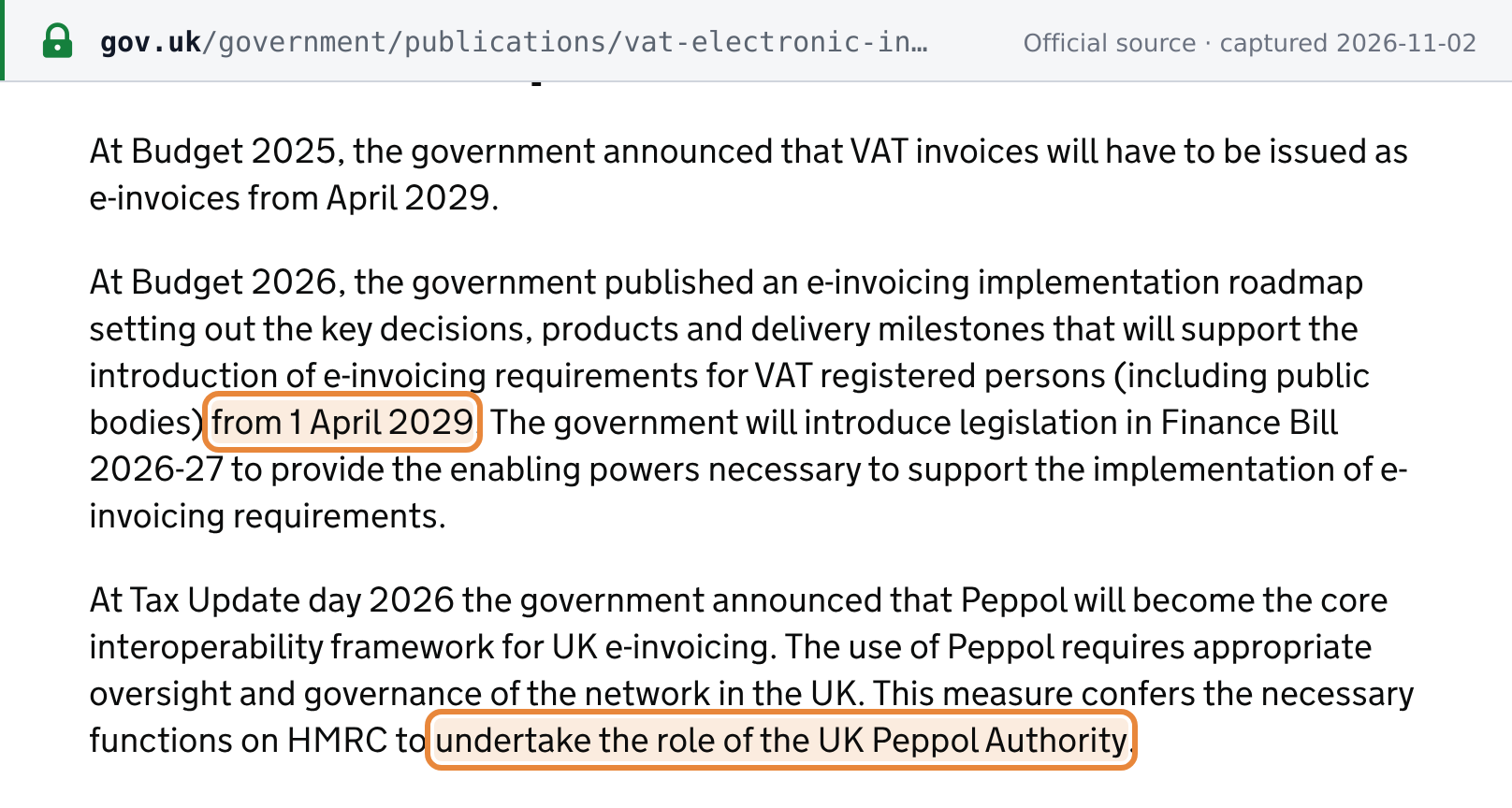 Source snapshot of the official page. Open full size ↗
The changes will take effect from April 2029.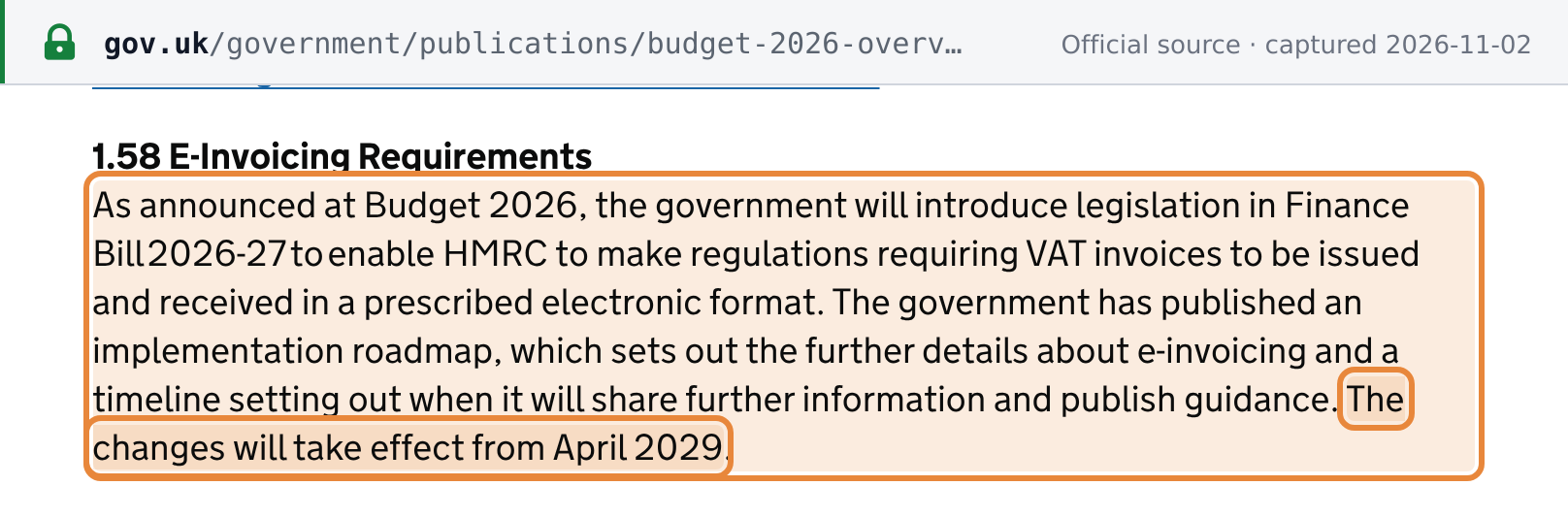 Source snapshot of the official page. Open full size ↗