Illinois drops the 200-transaction test for remote retailers from 1 January 2026
- Jurisdiction
- United States — Illinois
- Tax
- sales-tax
- Change type
- Threshold
- Status
- In force
- Impact
- FYI
- Announced
- 16 June 2025
- Effective
- 1 January 2026
- Instrument
- US-ACT-PA-104-0006
- Authority
- Illinois Department of Revenue
- Verified
- Fetched from official source · high confidence
Remote retailers and marketplace facilitators selling into Illinois, in particular those owing Retailers’ Occupation Tax only because of 200 or more transactions.
No action — monitoring only.
Illinois Public Act 104-0006 (HB 2755), signed June 16, 2025, removed the 200-transaction threshold from Illinois's economic nexus standard for remote retailers and marketplace facilitators, effective January 1, 2026. The sole remaining trigger is USD 100,000 in cumulative gross receipts from Illinois customers in the preceding 12-month period, checked on a rolling quarterly basis. Retailers that qualified only via the transaction prong must stop remitting Retailers' Occupation Tax on remote sales on or after January 1, 2026.
What changed in detail
Illinois Public Act 104-0006 removed the 200-transaction threshold from Illinois’s economic nexus standard for remote retailers and marketplace facilitators from 1 January 2026. The Act (HB 2755) was signed on 16 June 2025.
Before the change, a remote retailer or marketplace facilitator was treated as engaged in selling tangible personal property at retail in Illinois if, during a 12-month lookback period, it had either USD 100,000 or more in cumulative gross receipts from sales to Illinois purchasers or 200 or more separate transactions. It was then subject to State and local Retailers’ Occupation Tax (ROT) at destination rates.
On or after 1 January 2026, the only test is USD 100,000 or more in cumulative gross receipts during the lookback period. The Illinois Department of Revenue explained the change in Informational Bulletin FY 2026-12 (December 2025).
The same Act changes one more rule from 1 January 2026. Where a taxpayer fails to give enough information to locate a destination-based sale, the Department assesses tax on those receipts at a 15% undetermined-location rate, instead of applying unprocessable-return penalties. The Department may use that rate in audits of earlier periods too.
What it means
The change is in force. Illinois dropped the count after Wyoming, Indiana and Utah.
A retailer that qualified only on transaction count no longer owes ROT on remote sales from 2026. Its earlier periods still matter. The 2026 Remote Retailer Amnesty, open from 1 August to 31 October 2026, offered retailers that met the threshold a way to settle unpaid ROT for 2021 to mid-2026 without interest or penalties. For back periods not settled that way, an audit can now apply the 15% rate to any destination sales the retailer cannot locate.
Proof
the only threshold used to determine if a remote retailer or marketplace facilitator is engaged in the occupation of selling TPP at retail in Illinois and is subject to State and local ROT is whether the retailer makes $100,000 or more in cumulative gross receipts of sales of TPP to purchasers in Illinois during the lookback period. The 200-transaction threshold no longer applies.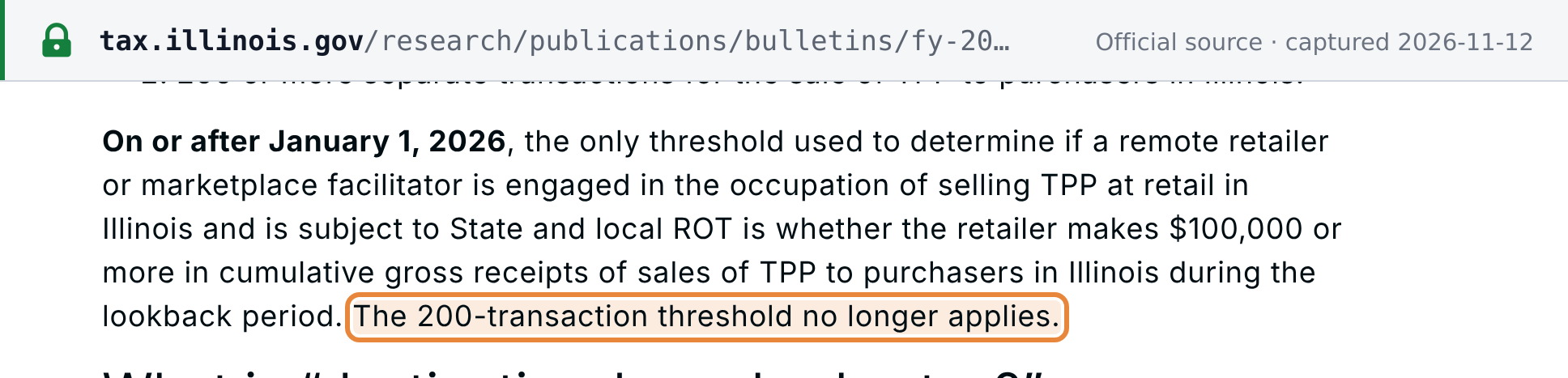 Source snapshot of the official page. Open full size ↗