Belgium makes 6% VAT on sales of demolished-and-rebuilt homes a standing rule from 29 July 2025
This page records one dated change. For the rules in Belgium as they stand today, see the Belgium guide →
- Jurisdiction
- Belgium
- Tax
- VAT
- Change type
- Rate change
- Status
- In force
- Impact
- Plan ahead
- Announced
- 29 July 2025
- Effective
- 29 July 2025
- Instrument
- BE-ACT-2025005578
- Authority
- SPF Finances (FPS Finance), Belgium
- Verified
- Fetched from official source · high confidence
Developers selling demolished-and-rebuilt dwellings, owners rebuilding to live in or let long-term, social-letting bodies, and their contractors and buyers.
Developers selling rebuilt dwellings, and owners rebuilding to occupy or let long-term, can apply 6% if the area caps (175 m² for developer sales to owner-occupiers or private tenants; 200 m² for own-account projects for an own home or private letting; no cap for social letting) and the 5- or 15-year use conditions are met. The electronic declaration must be sent before VAT becomes chargeable. Fossil-fuel heating components stay at the standard rate.
The Loi-programme of 18 July 2025 (Moniteur belge 29 July 2025, Numac 2025005578), art. 53, replaces rubric XXXVII of Table A of Royal Decree No. 20 from 29 July 2025 (art. 55). The 6% rate for demolishing a building and jointly rebuilding a dwelling on the same cadastral parcel now covers four standing cases. (1) A private owner's sole own home of up to 200 m². (2) Letting for at least 15 years through a social rental agency or social-housing body. (3) Letting for at least 15 years to a resident individual, up to 200 m². (4) Sales of the rebuilt dwelling, or of real rights in it, by the taxable person who demolished and rebuilt it, where VAT becomes chargeable from 1 July 2025. A sale qualifies if the buyer uses the dwelling as their sole own home (up to 175 m²), lets it through a social body, or lets it to a resident individual (up to 175 m²). Each case needs an electronic declaration before VAT becomes chargeable; for sales, the buyer countersigns it. The rate does not cover fossil-fuel central-heating components. The earlier transitional provisions are not carried over.
What changed in detail
Article 53 of the loi-programme of 18 July 2025 (Moniteur belge 29 July 2025, Numac 2025005578) replaces rubric XXXVII of Table A of Royal Decree No. 20. Under article 55 it applies from 29 July 2025.
The 6% rate for demolishing a building and jointly rebuilding a dwelling on the same cadastral parcel now covers four standing cases:
- a private owner’s sole own home, up to 200 m²;
- letting for at least 15 years through a social rental agency or social-housing body;
- letting for at least 15 years to a natural person who lives there, up to 200 m²;
- sales of the rebuilt dwelling, or of real rights in it, by the taxable person who demolished and rebuilt it, where the VAT becomes chargeable from 1 July 2025.
A sale qualifies if the buyer uses the dwelling as their sole own home (up to 175 m²), lets it through a social body, or lets it to a resident individual (up to 175 m²). Each case needs an electronic declaration before the VAT becomes chargeable; for sales the buyer countersigns it.
The rate does not cover the components of a fossil-fuel central-heating installation. The transitional paragraphs of the earlier versions are not carried over.
What it means
This is the current text. It replaces the May 2024 version and the extension to 30 June 2025, which together followed the January 2024 rewrite. The only later change is article 21 of the Law of 10 February 2026, which corrects the Dutch wording of §7, third subparagraph, a provision on projects with several dwellings. The French text and the rates are unchanged.
For developers the gain is permanence: no more permit-date cut-offs. The burden moves to the buyer’s use and the 175 m² cap. The heating carve-out works the same way as in renovation work.
Proof
par l’assujetti qui a procédé à la démolition d’un bâtiment et la reconstruction conjointe d’un bâtiment d’habitation situé sur la même parcelle cadastrale que ce bâtiment, lorsque la taxe due sur ces opérations est devenue exigible conformément à l’article 17, § 1er, du Code à partir du 1er juillet 2025.by the taxable person who carried out the demolition of a building and the joint reconstruction of a residential building on the same cadastral parcel as that building, where the tax due on those transactions became chargeable under Article 17, §1, of the Code from 1 July 2025.
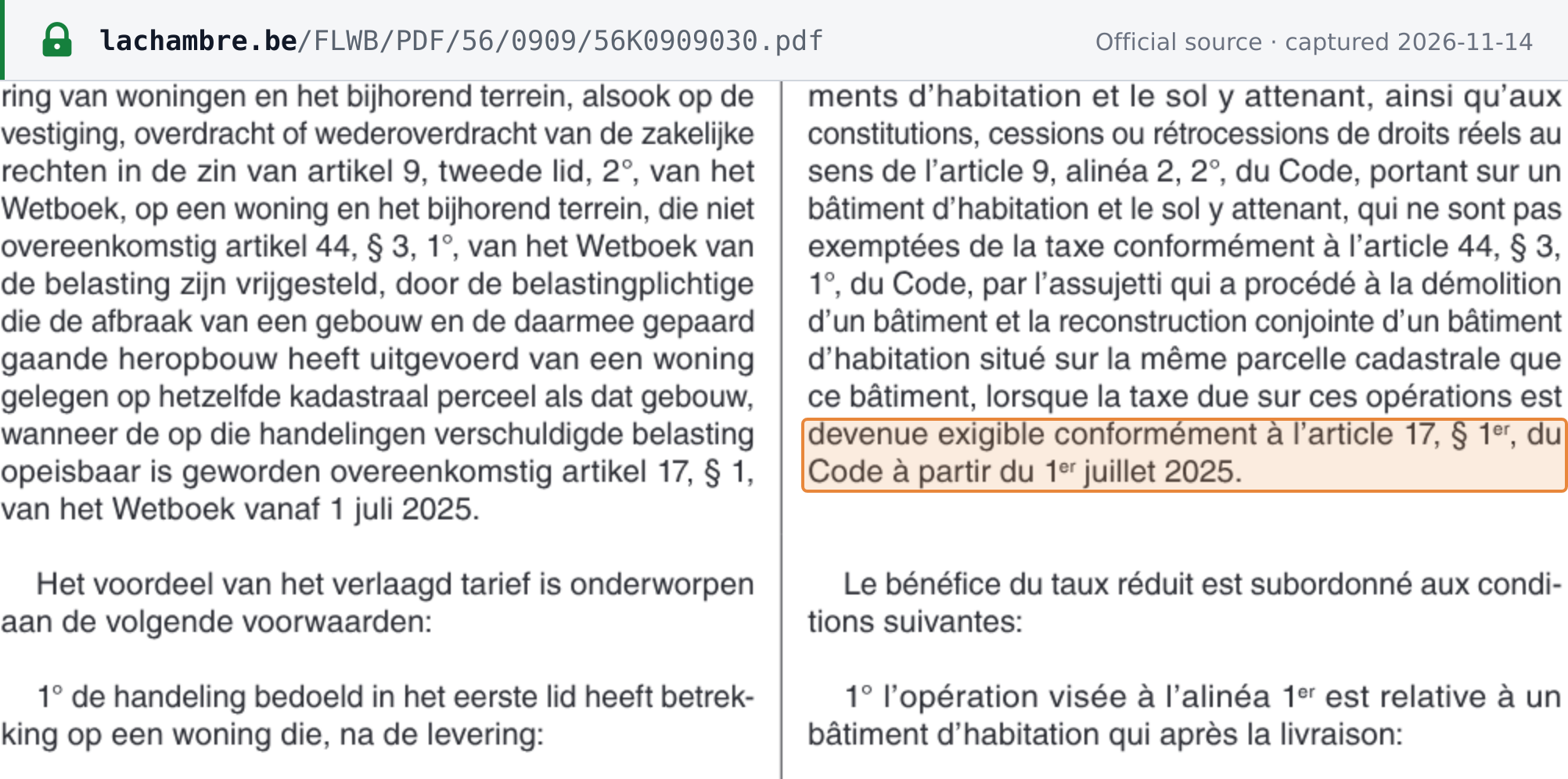 Source snapshot of the official page. Open full size ↗
Archived from the official distribution · Chambre des représentants, DOC 56 0909/030 (projet de loi-programme, articles adoptés en séance plénière; DOC 56 0909/031) · www.lachambre.be
par l'assujetti qui a procédé à la démolition d'un bâtiment et la reconstruction conjointe d'un bâtiment d'habitation situé sur la même parcelle cadastrale que ce bâtiment, lorsque la taxe due sur ces opérations est devenue exigible conformément à l'article 17, § 1er, du Code à partir du 1er juillet 2025.by the taxable person who carried out the demolition of a building and the joint reconstruction of a residential building on the same cadastral parcel as that building, where the tax due on those transactions became chargeable under Article 17, §1, of the Code from 1 July 2025.
Archived from the official distribution · Fisconetplus b38e1cae-8676-4324-9ef8-2ef04ffee07d: TVA, Arrêté royal n° 20 (coordination officieuse n° 39), Tableau A, rubrique XXXVII · www.minfin.fgov.be