Brazil cuts federal PIS/Cofins and IPI tax benefits by 10% from 1 April 2026
This page records one dated change. For the rules in Brazil as they stand today, see the Brazil guide →
- Jurisdiction
- Brazil
- Tax
- VAT
- Change type
- Rate change
- Status
- In force
- Impact
- Action required
- Announced
- 26 December 2025
- Effective
- 1 April 2026
- Instrument
- BR-COMPLEMENTARY-ACT-LC-n-224-2025
- Authority
- Imprensa Nacional — Diário Oficial da União
- Verified
- Fetched from official source · high confidence
Businesses using a federal PIS/Pasep, Cofins (domestic or import) or IPI exemption, zero rate, reduced rate or presumed credit, outside the Art. 4 §8 exclusions.
Businesses using a federal PIS/Cofins or IPI exemption, zero rate, reduced rate or presumed credit must apply the reduced benefit (10% of the standard rate, 90/10 blend, or 90% credit cap) to taxable events from 1 April 2026, unless an Art. 4 §8 exclusion applies.
Lei Complementar nº 224, de 26 de dezembro de 2025 (DOU Edição Extra nº 246-B, 26 December 2025), Art. 4 cuts federal tax incentives by roughly 10%, including those for PIS/Pasep, Cofins (domestic and import) and IPI. Exemptions and zero rates become a rate equal to 10% of the standard-system rate. A reduced rate becomes 90% of the reduced rate plus 10% of the standard rate, and presumed and other credits are capped at 90% (Art. 4 §4). Art. 4 §8 excludes the Zona Franca de Manaus, the cesta básica zero rates (LC 214 Annexes I and XV), ad rem rates and certain programmes. Under the nonagesimal rule (Art. 14, I, a), the cut applies to PIS/Cofins and IPI from 1 April 2026.
What changed in detail
Lei Complementar nº 224, de 26 de dezembro de 2025, was published in an extra edition of the Diário Oficial da União on 26 December 2025 (nº 246-B), with partial vetoes. Art. 4 reduces federal tax incentives and benefits, including those for PIS/Pasep, Cofins (domestic and import) and IPI; it also reaches IRPJ, CSLL, import duty and the employer contribution.
Art. 4 §4 sets how each benefit shrinks:
- exemption or zero rate: a rate equal to 10% of the standard-system rate;
- reduced rate: 90% of the reduced rate plus 10% of the standard rate;
- financial or tax credits, including presumed credits: use capped at 90% of the original credit.
For PIS/Pasep and Cofins the standard system is 1.65% and 7.6% (non-cumulative), 0.65% and 3% (cumulative), and 2.1% and 9.65% on imports of goods (Art. 4 §3). Art. 4 §8 excludes, among others, the Zona Franca de Manaus, the cesta básica zero rates in Annexes I and XV of LC 214/2025, ad rem rates, Prouni and Minha Casa, Minha Vida.
Under Art. 14, I, a, the cut applies to taxes subject to the 90-day rule, including PIS/Cofins and IPI, from the first day of the fourth month after publication: 1 April 2026.
What it means
The cut has applied since 1 April 2026 and is still in force, so an exemption or zero rate claimed on PIS/Cofins or IPI now usually means paying a small positive rate. The text has moved once: LC 235/2026 (27 August 2026) rewrote the non-profit exclusion in Art. 4 §8, V; the same law set the fiscal cover for the 2026 fuel PIS/Cofins cuts. Congress has also set rates directly for some regimes the law reaches, as LC 228/2026 did for the chemical industry. The horizon is short for PIS/Cofins: LC 214/2025 replaces them with the CBS from 2027 under EC 132, so for those contributions the cut matters mainly for 2026.
Proof
aplicação de alíquota correspondente a 10% (dez por cento) da alíquota do sistema padrão de tributaçãoapplication of a rate corresponding to 10% (ten percent) of the rate of the standard taxation system
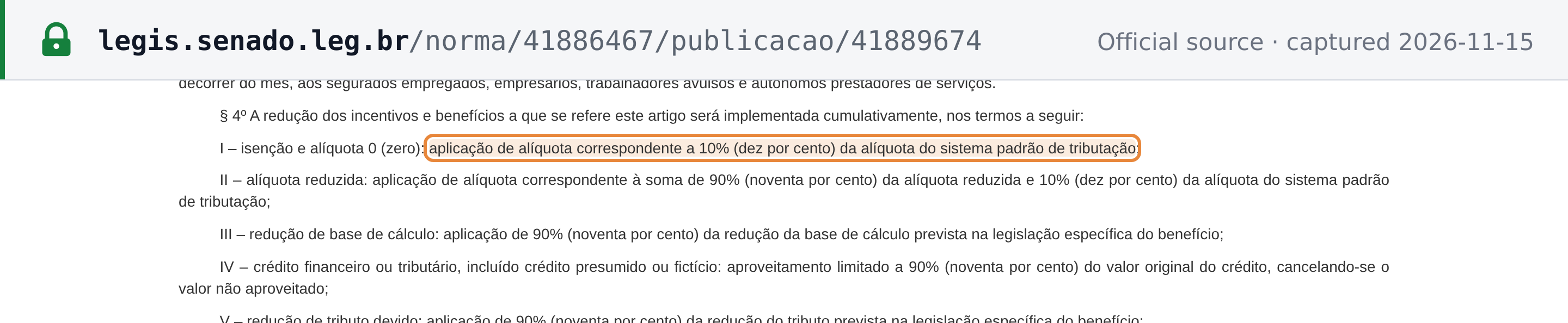 Source snapshot of the official page. Open full size ↗
Archived from the official distribution · Lei Complementar nº 224, de 26 de dezembro de 2025 — Senado Federal, Legislação (publicação) · legis.senado.leg.br