Brazil ties car IPI rates to vehicle attributes under the Mover programme (Lei 14.902/2024)
This page records one dated change. For the rules in Brazil as they stand today, see the Brazil guide →
- Jurisdiction
- Brazil
- Tax
- excise
- Change type
- Rate change
- Status
- In force
- Impact
- FYI
- Announced
- 28 June 2024
- Effective
- 1 April 2024
- Authority
- Imprensa Nacional — Diário Oficial da União
- Verified
- Fetched from official source · high confidence
Manufacturers and importers of cars and light commercial vehicles sold in Brazil, whose IPI rate depends on the vehicle’s attributes.
No action — monitoring only. Vehicle IPI rates follow the TIPI as amended by Decreto 12.549/2025; from 2027 IPI is reduced to zero except for Zona Franca de Manaus products (EC 132/2023), and MP 1.399/2026 (4 November 2026) carries the Decreto 12.549 attribute criteria into the 2027 Imposto Seletivo rates for vehicles (effects from 2 February 2027).
Lei nº 14.902, de 27 de junho de 2024 (DOU 28 June 2024), creates the Mover programme. Art. 9 has the Executive set IPI rates on cars and light commercial vehicles by their attributes, using a bônus/malus method. Vehicles meeting the requirements must get rates at least 2 points apart for energy efficiency, 1 point for structural safety and driver-assistance technology, and 2 points for recyclability (from 2025). Flex-fuel or ethanol hybrids may get up to 3 points less than comparable conventional vehicles until 31 December 2026 (§5). Arts. 9–11 apply from 1 April 2024 (Art. 35). Decreto 12.549/2025 implemented the scheme in the TIPI with effect from 1 November 2025 (Art. 4 and NC 87-15 from publication on 11 July 2025, Art. 8).
What changed in detail
Lei nº 14.902, de 27 de junho de 2024, published in the Diário Oficial da União on 28 June 2024, creates the Programa Mobilidade Verde e Inovação (Mover).
Art. 9 requires the federal Executive to set the IPI rates on cars and light commercial vehicles (§7) according to the vehicles’ attributes, using a bônus/malus method based on their negative or positive externalities (§1). For vehicles meeting specific requirements, the regulation must set rates that differ by at least:
- 2 percentage points for energy efficiency, measured tank-to-wheel;
- 1 percentage point for structural performance and driver-assistance technology;
- 2 percentage points for recyclability, from 1 January 2025.
Energy source and propulsion technology, power and the product’s carbon footprint are also taken into account (§3). Until 31 December 2026, hybrid vehicles with an ethanol-only or flex-fuel engine may have a rate up to 3 points lower than comparable conventional vehicles with the same type of engine (§5). Domestic and imported vehicles receive equal treatment (§8).
Under Art. 35, arts. 9 to 11 apply from 1 April 2024. Decreto nº 12.549, de 10 de julho de 2025, implemented the scheme in the IPI table (TIPI), with effect from 1 November 2025 (Art. 8; Art. 4 and NC 87-15, the sustainable-car classification, applied from publication).
What it means
The attribute-based rates are in force. Vehicle IPI now follows the TIPI as amended by Decreto 12.549/2025, so the rate for a given model depends on how it scores on efficiency, safety and recyclability, not only on engine size. The extra discount for flex-fuel and ethanol hybrids under §5 ends on 31 December 2026.
The rate scheme also has a short life left. Under the 2023 constitutional reform, IPI rates fall to zero from 2027 except for products with an industrial incentive in the Zona Franca de Manaus. The attribute-based differentiation does not disappear, though. Medida Provisória nº 1.399, de 4 de novembro de 2026, sets the 2027 Imposto Seletivo rates for vehicles from a base rate (6.3% for cars of heading 87.03, 3.9% for the listed light commercial vehicles), adjusted by the Decreto 12.549/2025 criteria for propulsion, energy efficiency, structural performance and driver assistance and power, and by recyclability. Vehicles with a sustainable-version registration under Art. 11 of Lei 14.902 that meet the criteria get a zero rate. The MP takes effect from 2 February 2027 and must still be converted into law by Congress. From 2027, then, Mover’s bônus/malus works through these Imposto Seletivo rates alongside the compensation mechanism of Art. 10, not through IPI. Manufacturers should plan their 2027 pricing on the IBS, CBS and the MP 1.399 Imposto Seletivo rates.
Proof
Art. 9º Com vistas a uma tributação destinada à sustentabilidade da mobilidade e logística do País, o Poder Executivo federal definirá as alíquotas do Imposto sobre Produtos Industrializados (IPI) de acordo com os atributos dos veículos de que trata o art. 2º desta Lei.Art. 9. With a view to taxation aimed at the sustainability of the country’s mobility and logistics, the federal Executive shall set the rates of the Tax on Industrialised Products (IPI) according to the attributes of the vehicles referred to in art. 2 of this Law.
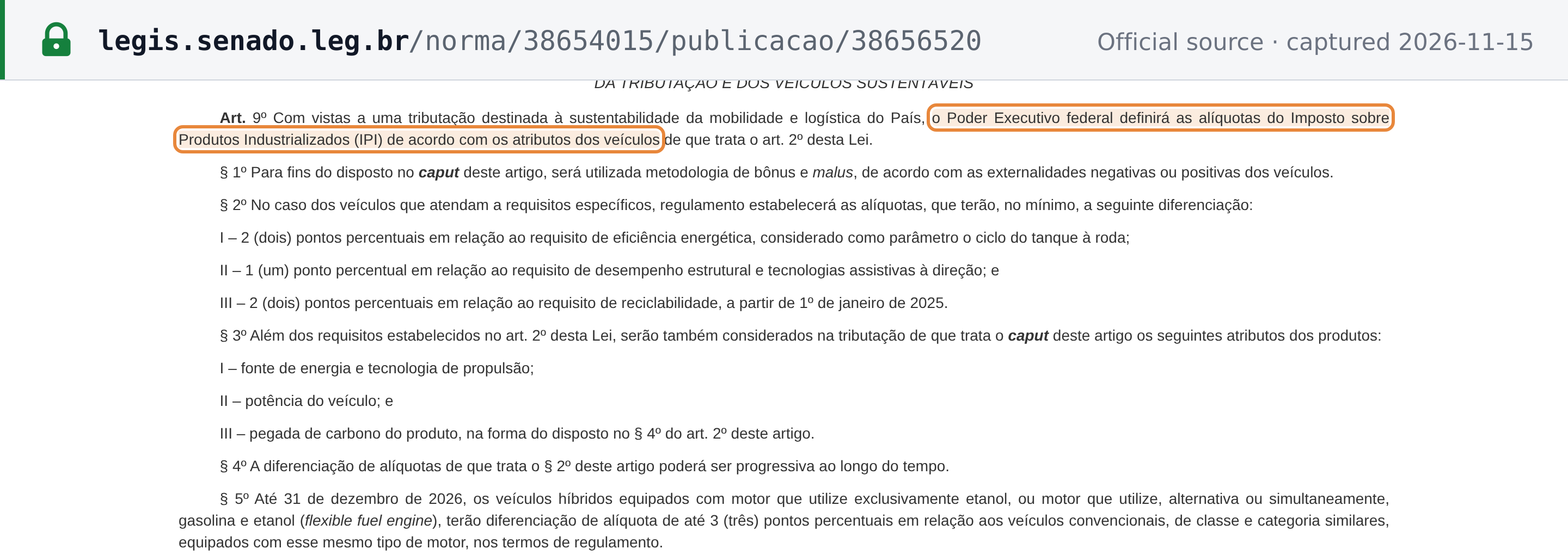 Source snapshot of the official page. Open full size ↗
Archived from the official distribution · Lei nº 14.902, de 27 de junho de 2024 — Diário Oficial da União de 28/06/2024 (p. 1, col. 2), text as published on Senado Federal Legislação · legis.senado.leg.br