Italy extends mandatory e-invoicing to all flat-rate (forfettario) taxpayers from 1 January 2024
This page records one dated change. For the rules in Italy as they stand today, see the Italy guide →
- Jurisdiction
- Italy
- Tax
- VAT
- Change type
- E-invoicing
- Status
- In force
- Impact
- FYI
- Announced
- 1 January 2024
- Effective
- 1 January 2024
- Instrument
- IT-DECRETO-LEGGE-36-2022
- Authority
- Gazzetta Ufficiale della Repubblica Italiana
- Verified
- Fetched from official source · high confidence
Forfettario and minimi taxpayers and L. 398/1991 associations with prior-year revenue up to EUR 25,000 that were not already covered from July 2022.
No action — monitoring only.
In force from 1 January 2024: the mandatory electronic invoicing obligation of D.Lgs. 127/2015, art. 1, comma 3, applies to all remaining taxpayers previously exempt under that provision, regardless of prior-year revenue: those in the forfettario flat-rate scheme, those in the 'regime di vantaggio' (minimi, DL 98/2011 art. 27) and entities that opted for L. 398/1991 with commercial proceeds up to EUR 65,000. DL 36/2022 (PNRR Decree), Art. 18, commi 2-3, removed the exemption, with a first phase from 1 July 2022 for those with prior-year revenues above EUR 25,000. The parent instrument was enacted April 2022; the 1 January 2024 commencement is the in-window event.
What changed in detail
Article 1, comma 3, of D.Lgs. 127/2015 makes electronic invoicing through the Sistema di Interscambio (SdI) mandatory in Italy. Until 2022 it exempted three groups: taxpayers in the “regime di vantaggio” (minimi, DL 98/2011 art. 27), those in the flat-rate forfettario regime, and entities that had opted for the L. 398/1991 regime with commercial proceeds up to EUR 65,000.
Decree-Law 30 April 2022, n. 36 (the PNRR Decree), Article 18, comma 2, deleted that exemption. Comma 3 phased the change in. It applied from 1 July 2022 to those whose revenue or fees in the previous year, scaled to a full year, exceeded EUR 25,000, and from 1 January 2024 to the remaining taxpayers.
On 1 January 2024 the second phase took effect. From that date every taxpayer in those three groups had to issue invoices electronically through the SdI, regardless of prior-year revenue. The parent instrument dates from April 2022; this record marks the 2024 start date.
What it means
The transition is complete. Since 1 January 2024, every former exemption holder in these three groups has had to issue electronic invoices. Paper or PDF invoices issued by a forfettario since then are not valid invoices for domestic B2B and B2C supplies. Buyers should expect SdI invoices from every Italian supplier, however small.
The obligation is still in force. From 1 January 2027, article 1 of D.Lgs. 127/2015 is abrogated by the VAT Testo unico, D.Lgs. 10/2026, which restates the e-invoicing rules in its own articles (record). Compliance checklists that cite D.Lgs. 127/2015 need updating.
Proof
a partire dal 1° gennaio 2024 per i restanti soggettifrom 1 January 2024 for the remaining taxpayers
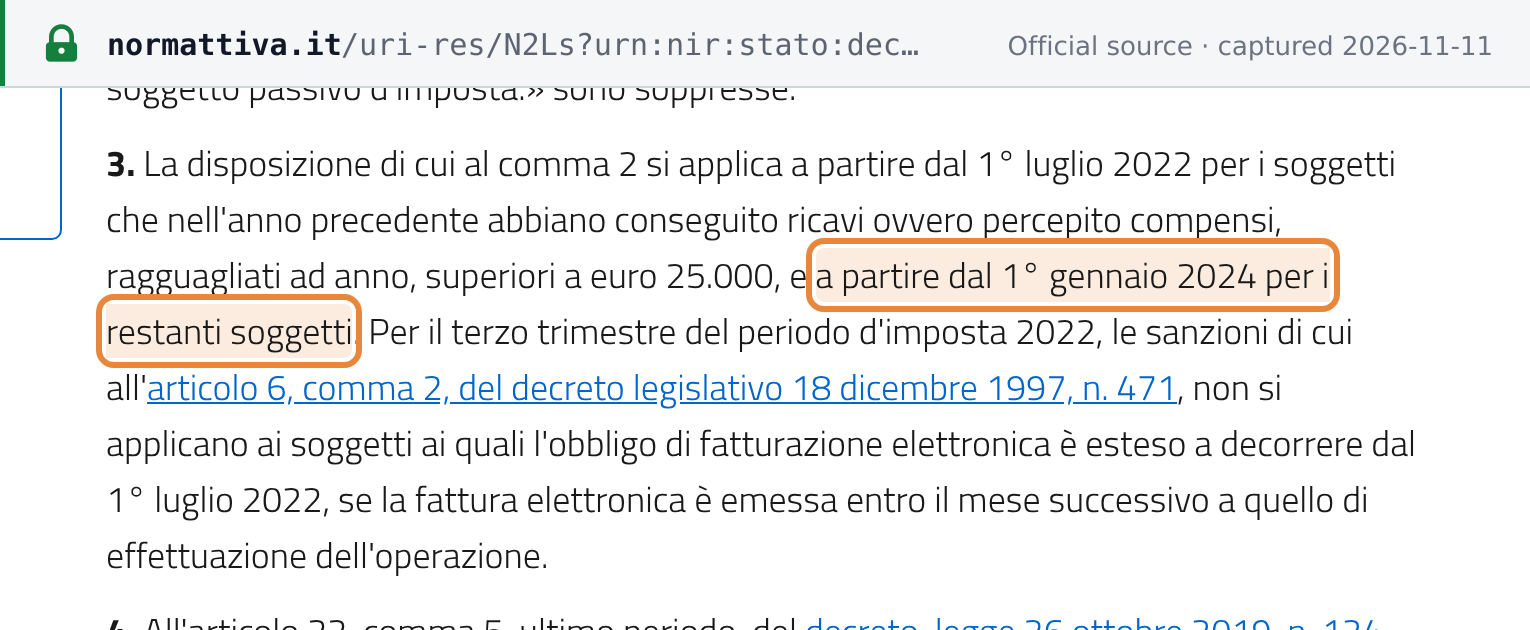 Source snapshot of the official page. Open full size ↗