Japan caps the transitional input credit for purchases from non-registered suppliers at ¥1 billion per supplier
This page records one dated change. For the rules in Japan as they stand today, see the Japan guide →
- Jurisdiction
- Japan
- Tax
- JCT
- Change type
- Compliance
- Status
- In force
- Impact
- FYI
- Announced
- 30 March 2024
- Effective
- 1 October 2024
- Instrument
- JP-ACT--6-8
- Authority
- 国会 (National Diet of Japan)
- Verified
- Fetched from official source · high confidence
Businesses buying more than ¥1 billion a year from a single supplier that is not a registered qualified invoice issuer (in tax periods beginning 1 October 2024 to 30 September 2026).
No action — superseded. The ¥1 billion cap applied to tax periods beginning 1 October 2024 to 30 September 2026. From tax periods beginning on or after 1 October 2026 the cap is ¥100 million (see jp-qualified-invoice-transition-reform-2026).
令和6年法律第8号 (FY2024 Tax Reform Act, promulgated 30 March 2024) amended supplementary Articles 52 and 53 of 平成28年法律第15号. Where a business's taxable purchases from a single non-registered supplier exceed ¥1 billion in a year (sole traders) or business year (corporations), the transitional 80% / 50% input credit for purchases without a qualified invoice is denied on the excess. The amendment commenced on 1 October 2024 and applies to tax periods beginning on or after that date. The FY2026 reform (令和8年法律第12号) later lowered the cap to ¥100 million for tax periods beginning on or after 1 October 2026.
What changed in detail
Since the qualified invoice system started on 1 October 2023, a purchase from a supplier that is not a registered invoice issuer gets no input credit, apart from a transitional measure. Under Supplementary Arts. 52 and 53 of 平成28年法律第15号 the buyer may credit 80% of the deemed tax on such purchases, falling to 50% in a later phase.
The FY2024 tax reform act, 所得税法等の一部を改正する法律 (令和6年法律第8号), promulgated on 30 March 2024, added a per-supplier cap to Art. 52(1). Art. 53 takes the cap over through its definition of purchases eligible for the credit. Where a business’s taxable purchases from one supplier exceed ¥1 billion in a year (sole traders) or business year (corporations), the transitional credit is denied on the part above ¥1 billion.
Supplementary Art. 1(3) of the 2024 Act brought the amendment into force on 1 October 2024, and Supplementary Art. 63 applies it to tax periods beginning on or after that date. For a calendar-year sole trader that meant from 1 January 2025.
What it means
This record is superseded. The FY2026 reform (令和8年法律第12号) cut the cap to ¥100 million per supplier for tax periods beginning on or after 1 October 2026. It also stretched the transitional credit into a 70% / 50% / 30% step-down ending 30 September 2031 (Japan re-schedules the qualified-invoice transitional credit). The current consolidated text of Supplementary Art. 52(1) reads 一億円.
The ¥1 billion figure governs only tax periods that began between 1 October 2024 and 30 September 2026. Buyers who still deal with a large non-registered supplier should test their purchases against ¥100 million.
Proof
当該事業者が、消費税法第二条第一項第三号に規定する個人事業者にあってはその年、法人にあってはその同項第十三号に規定する事業年度において一の事業者から行う当該課税仕入れに係る支払対価の額(新消費税法第三十条第八項第一号ニに規定する課税仕入れに係る支払対価の額をいう。以下この項、次条第一項及び附則第五十三条の二において同じ。)の合計額が十億円を超える場合における当該超える部分の課税仕入れを除く。Excluding, where the total consideration paid for such taxable purchases made from one business in the year (for a sole trader as defined in Consumption Tax Act Art. 2(1)(iii)) or in the business year (for a corporation, as defined in item (xiii) of that paragraph) exceeds ¥1 billion, the taxable purchases making up the excess. ("Consideration paid for taxable purchases" has the meaning in New CT Act Art. 30(8)(i)(d), here, in paragraph 1 of the next Article and in Supplementary Art. 53-2.)
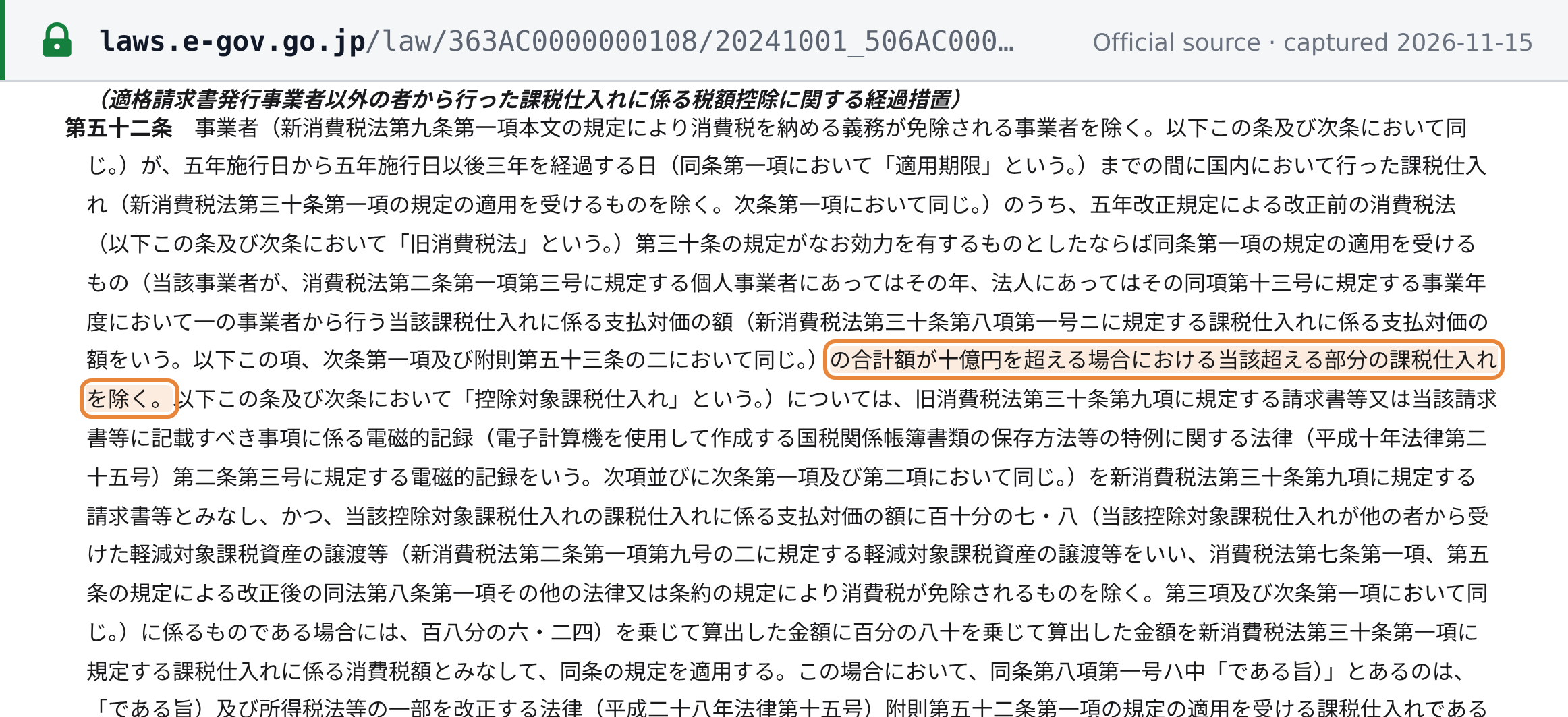 Source snapshot of the official page. Open full size ↗
Archived from the official distribution · 消費税法(昭和六十三年法律第百八号), e-Gov law revision 363AC0000000108_20241001_506AC0000000008, carrying 所得税法等の一部を改正する法律(平成二十八年法律第十五号)附則第五十二条第一項 as amended by 令和六年法律第八号 · laws.e-gov.go.jp