Philippines replaces official receipts with the VAT invoice and indexes the PHP 3 million VAT threshold (Ease of Paying Taxes Act, RA 11976)
This page records one dated change. For the rules in Philippines as they stand today, see the Philippines guide →
- Jurisdiction
- Philippines
- Tax
- VAT
- Change type
- Invoice rules
- Status
- In force
- Impact
- FYI
- Announced
- 5 January 2024
- Effective
- 22 January 2024
- Instrument
- PH-ACT-RA-11976
- Authority
- Congress of the Philippines
- Verified
- Fetched from official source · high confidence
All VAT-registered persons and percentage-tax payers in the Philippines, in particular sellers of services who previously issued official receipts.
No action — monitoring only. In force since 22 January 2024; watch for the first CPI adjustment of the PHP 3,000,000 VAT threshold and the PHP 500 invoice threshold, due every three years.
Republic Act No. 11976 (Ease of Paying Taxes Act), signed 5 January 2024, published in the Official Gazette on 7 January 2024, and effective 22 January 2024, amended Title IV (VAT) and Title V (Percentage Tax) of the NIRC: (1) the VAT invoice is now the sole supporting document for declaring output tax and claiming input tax, replacing the dual invoice/official-receipt system; (2) 'gross sales' replaces 'gross selling price', 'gross value in money', and 'gross receipts' as the tax base, adopting accrual-basis recognition for services; (3) the PHP 3,000,000 VAT registration threshold is indexed to the CPI every three years; (4) the mandatory-invoice issuance threshold is raised to PHP 500 (also CPI-indexed every three years); (5) a new output-VAT credit for uncollected receivables is introduced under Section 110(D); and (6) VAT refund claims are classified as low-, medium- or high-risk under Section 112(C). Implemented by RR 3-2024 (VAT/percentage-tax rules), RR 5-2024 (refund), RR 7-2024 (invoicing), and RR 8-2024 (taxpayer classification).
What changed in detail
Republic Act No. 11976, the Ease of Paying Taxes (EOPT) Act, was signed on 5 January 2024. According to the BIR, it was published in the Official Gazette on 7 January 2024 and took effect on 22 January 2024.
Its VAT and invoicing changes to the Tax Code, as the BIR summarises them:
- Invoice-only system: sales of goods and of services are treated alike, and both require an invoice. The VAT invoice is the sole supporting document for declaring output tax and claiming input tax. Official receipts no longer serve that purpose.
- Tax base: “gross sales” becomes the single base for sales of goods, services and leases, aligning VAT with accrual accounting.
- VAT threshold: the PHP 3,000,000 registration threshold is adjusted every three years in line with the Consumer Price Index published by the Philippine Statistics Authority.
- Invoice threshold: mandatory invoice issuance starts at PHP 500, also adjusted every three years.
- Invoice content: “business style” is no longer mandatory. Missing details do not cost the buyer the input tax unless they concern the amount of sales, the VAT, both parties’ names and TINs, the description, or the date.
- Uncollected receivables: output VAT on receivables not paid by the agreed date may be deducted in the next quarter, and added back on recovery.
- Refunds: VAT refund claims are classed as low, medium or high risk. Low-risk claims are not audited.
What it means
The Act is in force and remains the base for Philippine invoicing. The BIR implemented the invoicing rules in RR No. 7-2024, and RR No. 11-2024 set the transition for leftover official receipts. Both have since been built on. RR No. 6-2026 added a withholding-tax line to the invoice. The e-invoicing mandate under RR No. 11-2025 has a 31 December 2026 deadline under RR No. 26-2025.
The first three-yearly CPI review of the PHP 3 million and PHP 500 thresholds is the next date to watch. Until the BIR publishes adjusted figures, the statutory amounts apply.
Proof
Republic Act (RA) No. 11976, otherwise known as the “Ease of Paying Taxes (EOPT) Act”, was signed into law on January 5, 2024 by President Ferdinand R. Marcos, Jr., together with his VETO message. It was published in the Official Gazette on January 7, 2024 and took effect on January 22, 2024 or 15 days from its publication in the Official Gazette.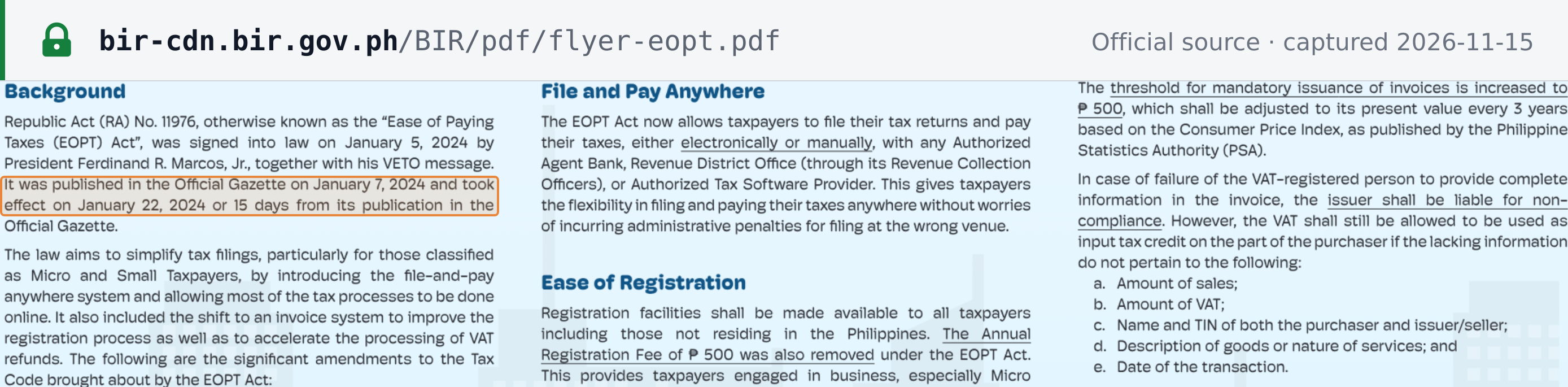 Source snapshot of the official page. Open full size ↗
Archived from the official distribution · Salient Features of Ease of Paying Taxes Act (Republic Act No. 11976), Bureau of Internal Revenue flyer, "Background" (p. 1) · bir-cdn.bir.gov.ph