Slovenia raises its small-business VAT threshold from €50,000 to €60,000 from 1 January 2025
This page records one dated change. For the rules in Slovenia as they stand today, see the Slovenia guide →
- Jurisdiction
- Slovenia
- Tax
- VAT
- Change type
- Threshold
- Status
- In force
- Impact
- FYI
- Announced
- 10 December 2024
- Effective
- 1 January 2025
- Instrument
- SI-ACT-ZDDV-1O
- Authority
- Finančna uprava Republike Slovenije (FURS)
- Verified
- Fetched from official source · high confidence
Taxable persons established in Slovenia with annual turnover in Slovenia (excluding VAT) around €50,000–€66,000, and EU businesses using the cross-border SME scheme in Slovenia.
No action — threshold in force since 1 January 2025; monitoring only.
Zakon o spremembah in dopolnitvah ZDDV-1 (ZDDV-1O), published in Uradni list RS No. 104/2024 (item 3310) on 10 December 2024 and in force from 11 December 2024, raised the domestic small-business (SME scheme) VAT threshold from €50,000 to €60,000 of annual turnover in Slovenia (previous and current calendar year), with a transitional ceiling of €66,000 in the year the threshold is crossed, effective 1 January 2025.
What changed in detail
The Act amending the Value Added Tax Act (ZDDV-1O) was published in Uradni list RS No. 104/2024 on 10 December 2024 and entered into force on 11 December 2024. It transposes Council Directive (EU) 2020/285 on the special scheme for small enterprises, with the threshold rules applying from 1 January 2025.
Under the domestic SME scheme as described by the financial administration (FURS), a taxable person established in Slovenia is exempt from charging VAT on supplies made in Slovenia if its annual turnover in Slovenia, excluding VAT:
- did not exceed €60,000 in the previous calendar year; and
- does not exceed €60,000 in the current calendar year.
The previous threshold was €50,000, which still governed the position on 31 December 2024.
A transitional ceiling of €66,000 applies in the year the €60,000 threshold is crossed. A small business that passes €60,000 may keep the exemption for the rest of that year unless turnover passes €66,000, in which case it must charge VAT from the transaction that crosses €66,000 and register for VAT. In either case it cannot use the exemption in the following calendar year, which FURS calls a quarantine.
The same Act opened the cross-border SME scheme, under which Slovenian businesses can use exemptions in other member states.
What it means
For a Slovenian sole trader or small company, the line to watch moved up by €10,000, with a 10% buffer in the year of crossing. That buffer only delays registration within the year; crossing €60,000 still means charging VAT for at least the next calendar year, so planning a year with turnover just above €60,000 has a cost a year later.
The threshold has applied since 1 January 2025 and is still the figure in FURS’s current description. The same Act also reclassified sweetened drinks (separate record) and introduced VAT groups from 2026 (separate record).
Proof
v preteklem koledarskem letu ni presegel zneska 60.000 evrov letnega prometa (brez DDV), na ozemlju Slovenije indid not exceed EUR 60,000 of annual turnover (excluding VAT) in Slovenia in the previous calendar year and
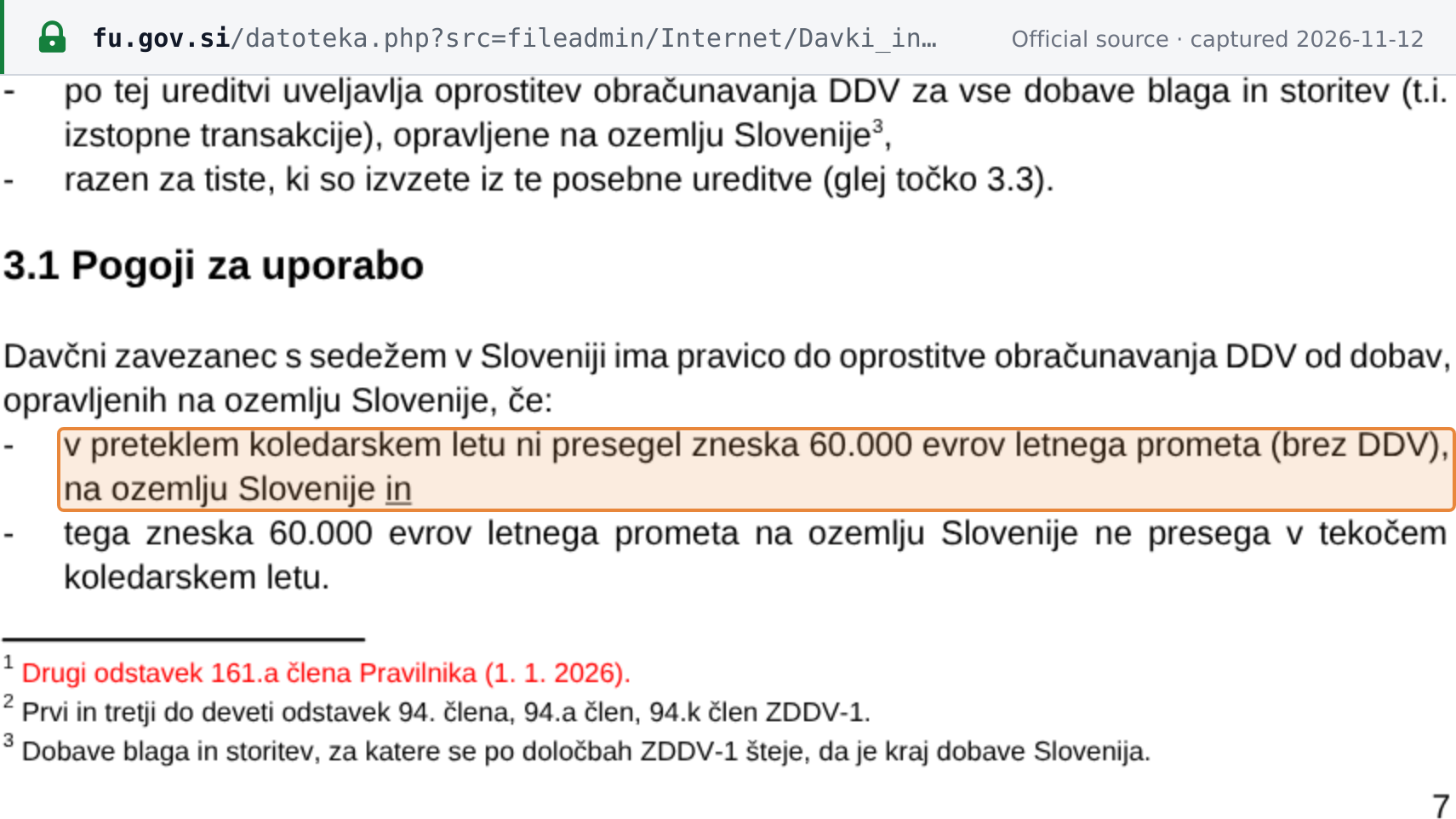 Source snapshot of the official page. Open full size ↗
Archived from the official distribution · FURS, Posebna ureditev za male davčne zavezance (SME ureditev), podrobnejši opis, section 3.1 · www.fu.gov.si