South Africa makes intermediaries the deemed supplier of electronic services only under a written agreement
This page records one dated change. For the rules in South Africa as they stand today, see the South Africa guide →
- Jurisdiction
- South Africa
- Tax
- VAT
- Change type
- Digital services
- Status
- In force
- Impact
- FYI
- Announced
- 24 December 2024
- Effective
- 1 April 2025
- Instrument
- ZA-ACT-42-of-2024
- Authority
- Parliament of the Republic of South Africa
- Verified
- Fetched from official source · high confidence
VAT-registered platforms and intermediaries that supply electronic services to persons in South Africa on behalf of principals, and those principals.
No action — monitoring only. Marketplaces and intermediaries that supply electronic services for principals should check whether a written s 54(2B) agreement is in place. Without one, the intermediary is no longer deemed the supplier. Act 5 of 2026 later removed the non-resident condition.
Taxation Laws Amendment Act 42 of 2024 (GG 51826, 24 December 2024) substituted s 54(2B) of the Value-Added Tax Act 89 of 1991 by s 51 of the Amendment Act, from 1 April 2025. Electronic services that a vendor intermediary supplies for a non-resident principal are deemed to be supplied by the intermediary only where the two agree in writing. The condition that the principal is not a registered vendor was removed. Where the parties agree, the principal and the intermediary are jointly and severally liable for the VAT duties and the tax on those supplies.
What changed in detail
Section 51 of the Taxation Laws Amendment Act 42 of 2024 (Government Gazette 51826, 24 December 2024) substitutes section 54(2B) of the Value-Added Tax Act 89 of 1991, from 1 April 2025 (section 51(2)).
Paragraph (a) applies where electronic services are supplied by an intermediary acting for a principal and:
- (i) the intermediary is a vendor;
- (ii) the principal is not a resident of the Republic; and
- (iii) the services are supplied to a person in the Republic.
The Act makes three changes to the earlier text:
- It deletes the words “and is not a registered vendor” from subparagraph (ii), so a principal that is itself registered can also fall within the rule.
- The supply is deemed made by the intermediary, not the principal, only where the principal and intermediary agree, in writing, to treat it that way. Without such an agreement, the deeming no longer applies.
- New paragraph (b): where they agree, subject to section 46, the principal and intermediary are jointly and severally liable for performing the duties under the Act and paying the tax on the supplies made under the agreement.
What it means
This version of section 54(2B) applied from 1 April 2025 to 31 March 2026. Taxation Laws Amendment Act 5 of 2026 then deleted subparagraph (ii), so resident principals can use the written-agreement rule too; see South Africa removes the non-resident condition from the electronic services intermediary rule. The written agreement and joint liability remain.
A further change is pending, not law: the Taxation Laws Amendment Bill B32-2026 would make the intermediary the deemed supplier by default from 1 April 2027 unless the parties agree otherwise (bill record). Whether a foreign supplier must register at all is a separate question; see South Africa’s B2B exclusion from electronic services.
Proof
(ii) the principal is not a resident of the Republic [and is not a registered vendor]; and (iii) the electronic services are supplied or to be supplied by the principal to a person in the Republic, that supply shall be deemed to be made by such intermediary and not by that principal where the principal and intermediary agree, in writing, to treat that supply as if made by the intermediary.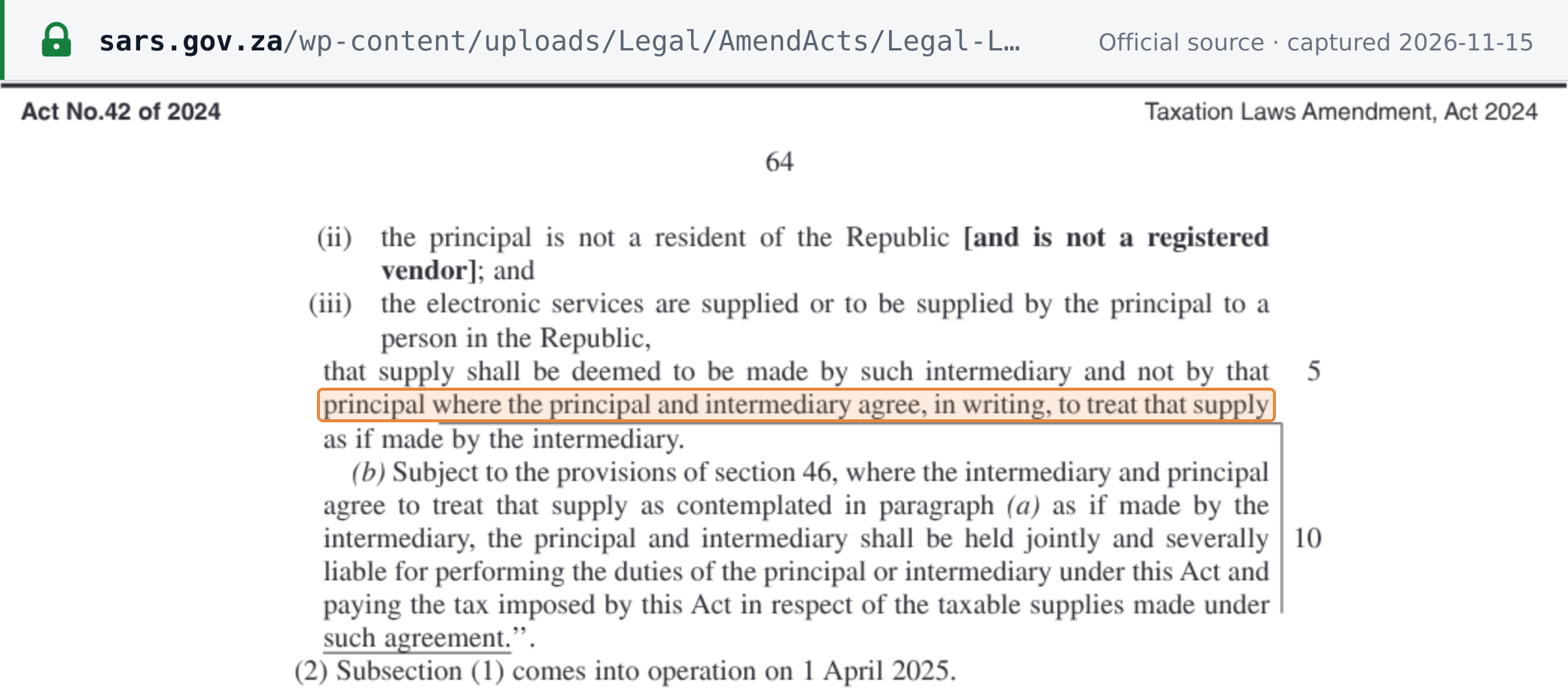 Source snapshot of the official page. Open full size ↗
Archived from the official distribution · Taxation Laws Amendment Act 42 of 2024, Government Gazette No. 51826, 24 December 2024 · www.sars.gov.za