UAE ends reverse-charge self-invoicing, caps VAT refund claims at five years and lets the FTA deny input tax tied to evasion
This page records one dated change. For the rules in United Arab Emirates as they stand today, see the United Arab Emirates guide →
- Jurisdiction
- United Arab Emirates
- Tax
- VAT
- Change type
- Compliance
- Status
- In force
- Impact
- Action required
- Announced
- 1 October 2025
- Effective
- 1 January 2026
- Instrument
- AE-FEDERAL-DECREE-LAW-16-2025
- Authority
- UAE Ministry of Finance
- Verified
- Fetched from official source · high confidence
UAE VAT taxable persons, in particular importers of goods or services under the reverse charge, businesses carrying excess recoverable VAT, and any business deducting input tax.
Since 1 January 2026, stop issuing self-invoices for import reverse charge (keep the supporting documents the Executive Regulation requires); claim refunds of excess recoverable tax within five years of the period it arose or lose it; verify suppliers and supplies under FTA Decision No. 13 of 2026 before deducting input tax.
Federal Decree-Law No. 16 of 2025, issued 1 October 2025 and effective 1 January 2026, amends the VAT Decree-Law (No. 8 of 2017). Article 48(1) now exempts a taxable person accounting for VAT under the reverse charge on imported goods or services from issuing a tax invoice to itself; amended Article 74(3) lets excess recoverable tax be carried forward for at most five years from the end of the tax period in which it arose, after which the right to claim it lapses; new Article 54 bis requires the FTA to reject, and allows it to reject, input tax deductions on supplies linked to tax evasion, treating a taxable person who did not verify its supplies under FTA-set measures as on notice. Article 79 bis (statute of limitation) is repealed.
What changed in detail
Federal Decree-Law No. 16 of 2025, issued on 1 October 2025 and effective 1 January 2026, amends the UAE VAT Decree-Law (Federal Decree-Law No. 8 of 2017). The Ministry of Finance announced it on 3 December 2025. It makes four changes:
- Article 48(1), reverse charge on imports. A taxable person importing concerned goods or services still accounts for the VAT and meets every other obligation, but no longer issues a tax invoice to itself. The Ministry’s announcement says the supporting documents specified by the Executive Regulation must be kept instead.
- Article 74(3), excess recoverable tax. Excess not refunded or offset is carried forward for at most five years from the end of the tax period in which it arose. If no refund request is made and the excess is not used against tax liabilities within that time, the right to claim it lapses.
- New Article 54 bis, input tax and evasion. The FTA shall reject a deduction where the supply was part of a chain linked to tax evasion and the taxable person knew it. It may reject one where the person should have known. A person who did not verify its supplies under the FTA’s measures before deducting is treated as having been required to know.
- Article 79 bis, the statute-of-limitation article added in 2022, is cancelled.
What it means
All four changes are in force. The FTA’s November 2025 consolidation is the latest it publishes, and no later amendment to these articles has been found.
The FTA set out the verification measures behind Article 54 bis in FTA Decision No. 13 of 2026, effective 1 October 2026. Since then, an input-tax claim depends on documented supplier checks.
The five-year limit is a hard cut-off. Businesses holding old credit balances should identify which tax period each balance arose in and file refund requests before it lapses. Importers can drop self-billing from their reverse-charge process, but they still need to keep the records required by the Executive Regulation.
Proof
shall be responsible for accounting for the Due Tax on that Supply and complying with all other Tax obligations arising, with the exception of issuing a Tax Invoice to himself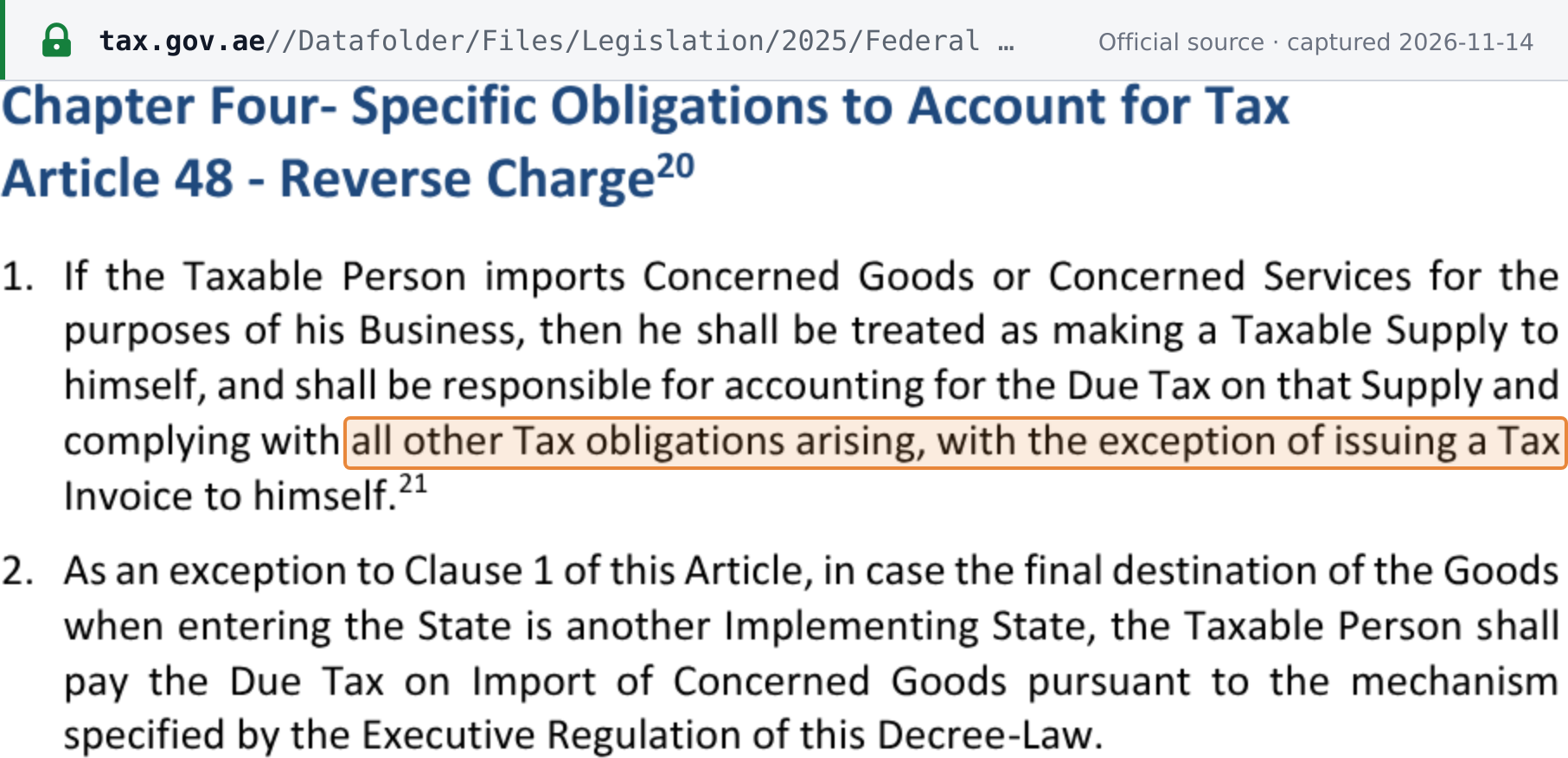 Source snapshot of the official page. Open full size ↗
Archived from the official distribution · Federal Decree-Law No. 8 of 2017 and its amendments, consolidated to Federal Decree-Law No. 16 of 2025 – Issued 1 Oct 2025 (Effective from 1 Jan 2026); Article 48(1); English text marked "This is not an official Translation" · tax.gov.ae
The Ministry of Finance has announced the issuance of Federal Decree-Law No. (16) of 2025 amending certain provisions of Federal Decree-Law No. (8) of 2017 on Value Added Tax, which will enter into force as of January 1, 2026. Source snapshot of the official page. Open full size ↗