Japan bars foreign businesses with no permanent establishment from the simplified JCT method and the 2-wari special
This page records one dated change. For the rules in Japan as they stand today, see the Japan guide →
- Jurisdiction
- Japan
- Tax
- JCT
- Change type
- Compliance
- Status
- In force
- Impact
- FYI
- Announced
- 30 March 2024
- Effective
- 1 October 2024
- Instrument
- JP-ACT--6-8
- Authority
- 国会 (National Diet of Japan)
- Verified
- Fetched from official source · high confidence
Foreign businesses (国外事業者) registered or liable for Japanese consumption tax that have no permanent establishment in Japan on the first day of the tax period.
No action — in force for tax periods beginning on or after 1 October 2024. A foreign business with no PE in Japan at the start of a tax period must compute input credit in full (no simplified method, no 2-wari special).
令和6年法律第8号 (FY2024 Tax Reform Act, promulgated 30 March 2024) amended Consumption Tax Act Article 37(1) and supplementary Article 51-2(1) of 平成28年法律第15号 so that a foreign business (国外事業者) with no permanent establishment in Japan on the first day of a tax period cannot use the simplified calculation method (簡易課税制度) or the 2-wari special rule (2割特例) for that period. The amendments commenced on 1 October 2024 and apply to tax periods beginning on or after that date.
What changed in detail
The FY2024 tax reform act, 所得税法等の一部を改正する法律 (令和6年法律第8号), promulgated on 30 March 2024, amended two provisions with the same exclusion:
- Consumption Tax Act Art. 37(1), the simplified calculation method (簡易課税制度), which lets a business with base-period taxable sales of ¥50 million or less compute input credit as a deemed percentage of output tax. The amended text excludes a foreign business (国外事業者) that has no permanent establishment, as defined in the Income Tax Act or the Corporation Tax Act, on the first day of the tax period.
- Supplementary Art. 51-2(1) of 平成28年法律第15号, the 2-wari special rule (2割特例) for formerly exempt businesses that registered as qualified invoice issuers. It carries the same exclusion.
Supplementary Art. 1(3) of the 2024 Act brought both amendments into force on 1 October 2024. Supplementary Arts. 13(10) and 63 apply them to tax periods beginning on or after that date; earlier periods follow the old rules. Whether a business has a permanent establishment is tested on the first day of each tax period, so the result can change from one period to the next.
What it means
The exclusion is still in force: the current consolidated text of Art. 37(1) carries it unchanged. A foreign business with no PE in Japan computes input credit from actual purchases backed by qualified invoices.
The 2-wari special itself has since ended. It closed with tax periods that include 30 September 2026, and individuals get a 30% version (3-wari) for 2027 and 2028 (Japan ends the 2-wari special). The 3-wari provision takes its definition of an eligible issuer from Art. 51-2(1), so the no-PE exclusion carries over to it. This rule sits beside the 2024 change that ended the exemption on entry for foreign corporations with ¥10 million or more of capital (Japan ends the small-business exemption for capitalised foreign corporations).
Proof
事業者(第九条第一項本文の規定により消費税を納める義務が免除される事業者及びその課税期間の初日において所得税法第二条第一項第八号の四(定義)又は法人税法第二条第十二号の十九(定義)に規定する恒久的施設を有しない国外事業者を除く。)A business (excluding a business exempt from tax under the main clause of Article 9(1), and a foreign business that, on the first day of the tax period, has no permanent establishment as defined in Article 2(1)(viii-4) (Definitions) of the Income Tax Act or Article 2(xii-19) (Definitions) of the Corporation Tax Act)
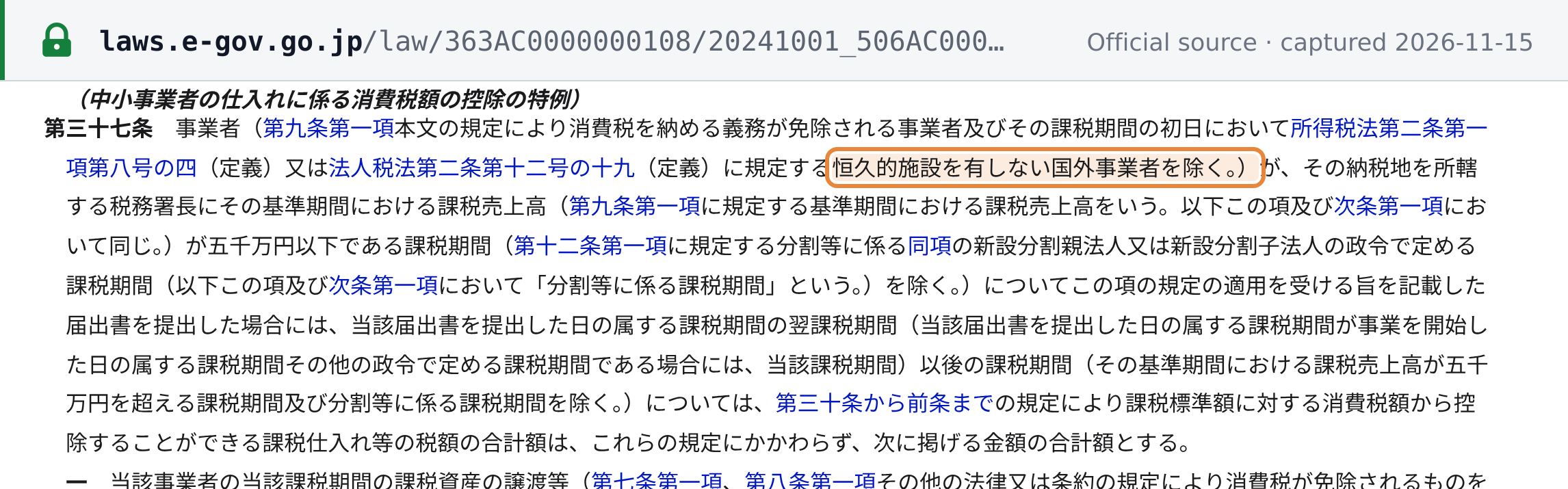 Source snapshot of the official page. Open full size ↗
Archived from the official distribution · 消費税法(昭和六十三年法律第百八号), e-Gov law revision 363AC0000000108_20241001_506AC0000000008 (as amended by 令和六年法律第八号, in force 2024-10-01), Art. 37(1); same exclusion in 平成二十八年法律第十五号附則第五十一条の二第一項 · laws.e-gov.go.jp